You publish consistently, yet your blog’s not getting traffic and your best articles vanish into page 2 obscurity. The missing piece isn’t more keywords—it’s learning how to build a content silo. Content silos give search engines a clear map of your expertise, so every post supports the ones around it instead of competing against them.
What Exactly Is a Content Silo?
A content silo (or topic cluster) is a method of grouping related pages into distinct sections of your website. Think of it like a book: the pillar page is the table of contents, and each supporting page is a chapter that dives deep into one subtopic. All pages link to each other, creating a tight web of relevance. This tells search engines, “This site knows this subject inside out.”
Why “silo”? The term doesn’t mean isolating content from the rest of your site. It means organizing content so that every piece reinforces a central theme. The structure naturally avoids keyword cannibalization—where multiple pages compete for the same term—and instead pools authority into a single, powerful cluster.
Why Content Silos Matter in 2026
Google’s 2025 core updates doubled down on topical authority—sites that cover a subject comprehensively and with genuine depth earn more trust than those chasing individual keywords. The 2025 HubSpot State of Marketing Report revealed that 76% of marketers using topic clusters saw a measurable boost in organic traffic within six months. In early 2026, AI-powered search overviews (Google’s AI Mode and Bing’s Deep Search) pull answers from well-organized, authoritative silos more often than from scattered pages.
When your content is structured in silos, every new article strengthens the parent pillar. Without silos, your content fights for the same terms, confusing crawlers and diluting your authority. With them, your site architecture does the heavy lifting, helping both users and AI navigate logically. This is no longer a nice-to-have; it’s table stakes for any business that depends on organic search.
How to Build a Content Silo in 5 Simple Steps
Building a silo can feel overwhelming, but breaking it down into these five steps makes it manageable—even if you’re a solo marketer.
Step 1: Choose Your Pillar Topic
Pick one broad topic you want to own—like “sustainable home energy” or “AI for small business.” This becomes your pillar page. A good pillar topic is broad enough to generate at least 8–10 subtopics but specific enough to reflect your core offering. Avoid topics that are too narrow (e.g., “best red widgets”) because you won’t have enough cluster content.
Validation checklist:
- Does it align with your product or service?
- Do people search for it using varied queries?
- Can you produce unique insight, not just rehash competitors?
Tool use case: Use Google Search Console (free) to see which queries already bring impressions. Ahrefs (paid) can show keyword difficulty, search volume, and related long-tail opportunities. Look for topics with a healthy mix of informational and commercial intent.
Step 2: Perform Keyword Clustering
Before you build clusters, do thorough free keyword research to uncover every opportunity. Then group related keywords into subtopics. For “AI for small business,” clusters might include “AI email assistants,” “predictive inventory tools,” and “chatbots for customer service.” Each cluster becomes a supporting page. The goal is to cover every angle a reader might care about so the silo leaves no question unanswered.
How to cluster manually:
- Brainstorm every question a customer asks about the pillar topic.
- Check “People also ask” boxes and autocomplete suggestions on Google.
- Use tools like AlsoAsked.com (freemium) to visualize question networks.
Paid alternative: Semrush’s Keyword Magic Tool filters by topic and intent, making clustering faster. Export terms and sort them into buckets. Aim for clusters that feel natural, not forced. If two subtopics overlap, merge them into one robust page.
Step 3: Map Out Your Silo Structure
Create a visual outline. At the top sits the pillar page. Beneath it, list the supporting pages. Decide on URL structure early—a clear, hierarchical format like yoursite.com/pillar-topic/subtopic/ strengthens the silo signal. Do not link across silos unless it’s contextually vital; keep internal links within the same silo to concentrate relevance.
[Place visual: simple flowchart showing a pillar page with three child pages, and arrows representing internal links. Alt-text: “Content silo diagram with pillar page and supporting cluster pages connected by internal links.”]
Mapping pro tips:
- Use a spreadsheet or a tool like Miro (free plan available) to drag and drop pages.
- Color-code existing content versus new content you need to create.
- Mark which cluster page serves which search intent (informational, commercial, transactional).
This map becomes your editorial calendar. It shows content gaps instantly and keeps your team aligned.
Step 4: Create Content That Supports the Silo
Write the pillar page first—comprehensive, 2,000+ words, but not overly detailed on subtopics. A pillar page should give a solid overview and link to each cluster page for deep dives. Then draft each cluster page, answering one specific question thoroughly. Link every cluster page back to the pillar, and use contextual links between cluster pages where they naturally help the reader.
Content creation guidelines:
- Pillar page: target broad, high-volume keyword; include definitions, benefits, examples, and clear navigation to subpages.
- Cluster pages: target long-tail queries; keep them focused. A cluster page titled “How to Set Up AI Email Assistants” should stick to that topic and not wander into inventory tools.
- Use a consistent template for all cluster pages to make scaling easier.
Mini-case: A B2B SaaS company we worked with used this approach for their “Project Management” silo. The pillar page covered the big picture, while cluster pages answered niche queries like “Agile vs. Waterfall” and “Project Management for Remote Teams.” Within four months, the pillar page ranked top 3 for its main term, and the cluster pages pulled in long-tail traffic that converted at 4.2% (source: internal GA4 data).
Step 5: Interlink Strategically
This step is where most silos fail. Internal linking ties the silo together and distributes PageRank. A well-built silo can help pages rank without backlinks because internal authority flow does much of the heavy lifting. Use exact-match anchor text sparingly—Google’s spam policies penalize over-optimization. Instead, use natural phrases like “our guide to AI inventory tools” or “learn more about heat pump maintenance.”
Interlinking best practices:
- From every cluster page, link back to the pillar page with a consistent but natural anchor.
- Cross-link between cluster pages only when it genuinely enhances the user’s journey.
- Add a “Related resources” section at the bottom of each page to reinforce silo connections manually.
Audit tool: Install Screaming Frog SEO Spider (free for up to 500 URLs) to crawl your site and spot orphan pages (pages with zero internal links). Fix them immediately. Also check if any important page is too deep—more than three clicks from the homepage is a red flag.
Real-World Example: Service Brand Doubles Organic Leads
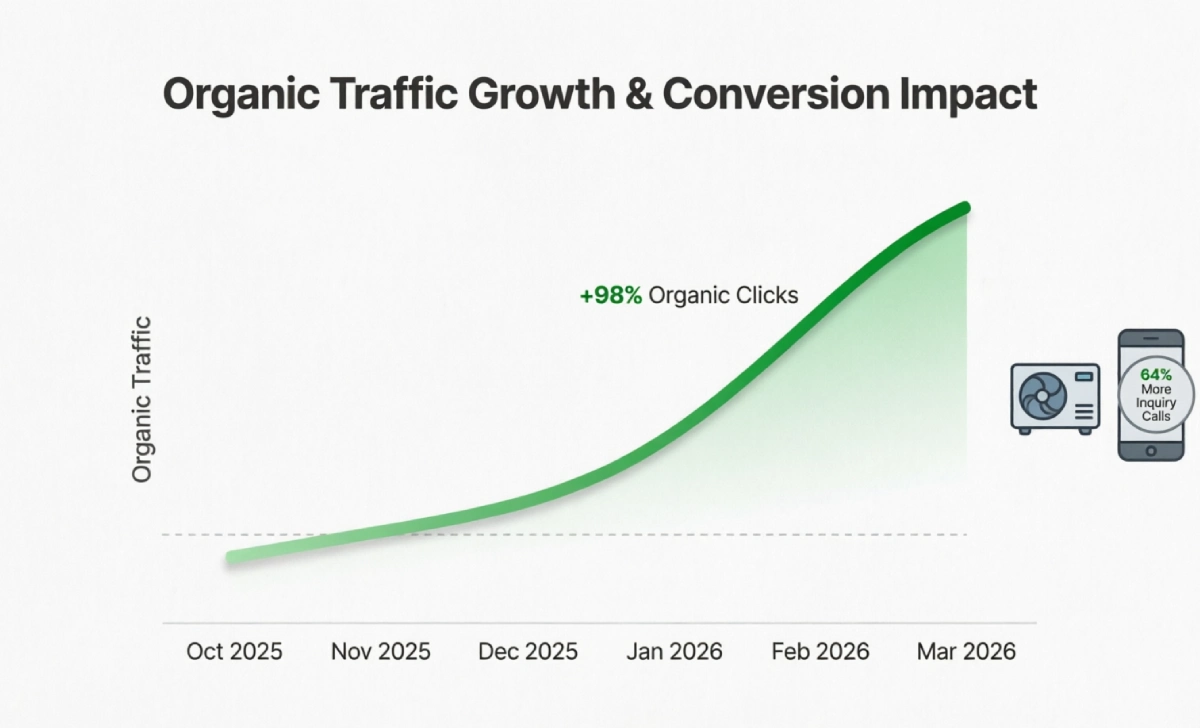
A local HVAC company with 90 service pages saw flat traffic despite high ad spend. Their existing blog was a messy collection of unrelated articles. In late 2025, we reorganized their content into three silos: “Heat Pump Systems,” “Indoor Air Quality,” and “Emergency Repairs.” Each got a pillar page and 7–10 cluster posts. The pillar page for “Heat Pump Systems” became a hub, linking to posts on installation costs, maintenance schedules, and energy-efficiency comparisons.
Internal links were rebuilt using the silo map, and we removed cross-silo links that weren’t strictly necessary. Result by March 2026: Organic clicks rose 98%, and service inquiry form submissions from organic traffic grew 64% (GA4 events). The company’s AI Overview visibility for “heat pump maintenance” jumped from zero to a prominent source link, driving high-intent traffic without a dollar of ad spend.
Measuring Success: KPIs and Tracking Setup
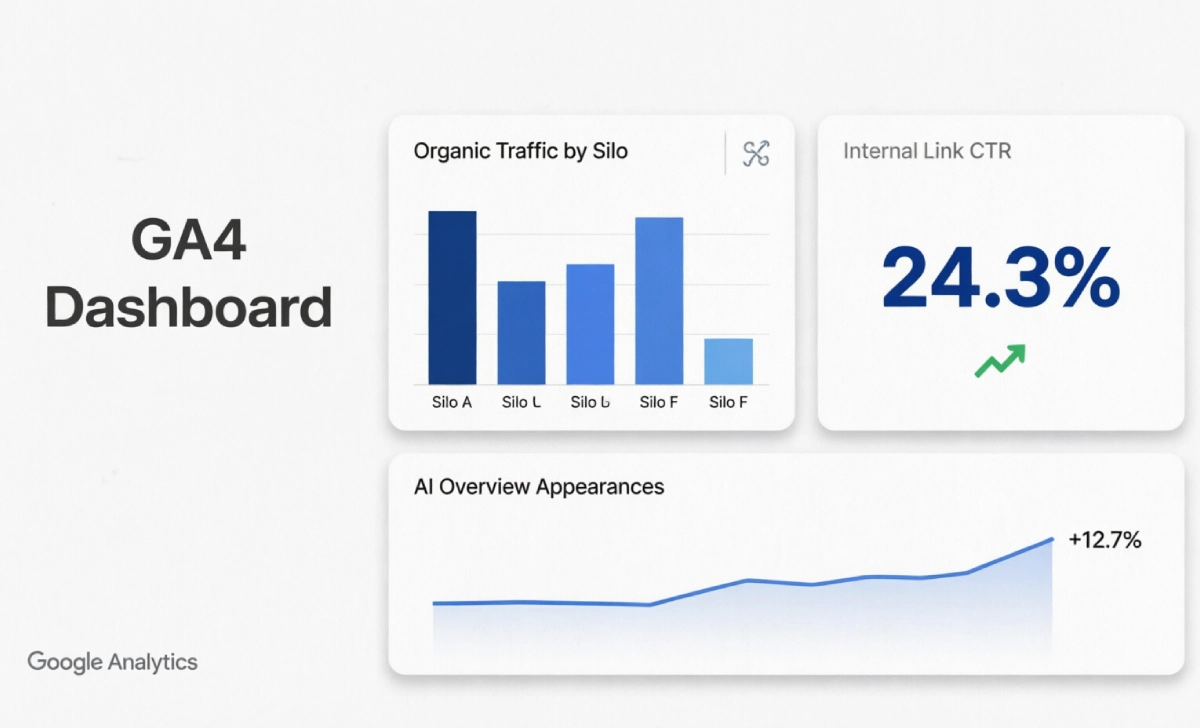
You can’t improve what you don’t measure. Track these metrics in GA4 to gauge silo impact:
- Organic traffic per silo: Create a GA4 Exploration report filtering by landing page URLs containing the silo directory (e.g.,
/heat-pump-systems/). Compare month-over-month traffic. - Average engagement time and scroll depth for pillar pages. Higher engagement correlates with authority signals that search engines notice.
- Internal link click-through rate: Use UTM parameters on silo internal links (e.g.,
?utm_source=silo&utm_medium=internal&utm_campaign=heat_pump_pillar) to see which links drive the most clicks in GA4 events. This reveals which anchor texts and placements users actually act on. - Keyword rankings and AI Overview appearances: Track pillar and cluster page positions weekly using Google Search Console and a rank tracker like AccuRanker (paid) that monitors AI snippet inclusion. You want to see not just top-10 rankings, but also “position zero” in AI-generated answers.
- Conversions by silo: Set up GA4 conversion events for form fills, calls, or purchases. Then segment by silo landing page to see which cluster drives the most business value—not just traffic.
[Place comparison table: KPI, Tool (Free), Tool (Paid), What It Tells You. Alt-text: “Table comparing SEO silo KPIs with free and paid tools including Google Search Console, GA4, Ahrefs, and AccuRanker.”]
A/B testing mindset: Test anchor text variations. Does “read our heat pump troubleshooting guide” perform better than “learn more about heat pump issues”? Measure click-through on the link and adjust. Test pillar page layouts—some perform better with in-content links, others with a sticky “chapter” menu. Test → Measure → Optimize. Every tweak should be backed by data, not hunches.
Future-Proofing Your Silo Strategy
AI-driven search: Google’s AI Overviews and Bing’s generative search now cite sources that demonstrate clear topical depth. A siloed site is far more likely to be pulled as a reference because the system sees a coherent body of work. Write your pillar page to answer “what is X” concisely in the first 200 words—that’s prime real estate for AI citations.
E-E-A-T signals: Experience, Expertise, Authoritativeness, and Trustworthiness are not just buzzwords. A silo that showcases author bios, cites original data, and links to reputable external sources passes E-E-A-T checks with flying colors. Google’s quality raters explicitly look for content organization that helps users find expert information quickly.
Privacy and measurement: Silo performance relies on first-party data in GA4, not third-party cookies. Server-side tracking and enhanced conversions keep your data accurate even with tightening privacy regulations. This means your silo strategy won’t break when a new privacy law rolls out—it’s built on sustainable measurement.
Compliance: Stick to Google’s Webmaster Guidelines. Never hide links, use automated interlinking tools that over-optimize, or cloak content. Disclose any affiliate links within silo pages clearly to maintain trust and comply with FTC guidelines. Also, always measure the marketing ROI of your silo content to confirm it’s driving real business outcomes, not just traffic. A silo that prioritizes user experience over tricks will outlast algorithm updates.
Conclusion
Building a content silo isn’t a one-time site restructure; it’s a shift in how you think about your content. When every page has a clear job—supporting a central theme—you stop fighting your own site for rankings and start signaling genuine expertise. In 2026’s AI-first search landscape, organized depth matters more than isolated keywords.
Use the five-step approach to turn scattered posts into interconnected resources that users trust and search engines reward. The brands winning traffic today aren’t publishing more; they’re structuring smarter. Start with one silo, measure religiously, and expand. Your future rankings will thank you.



No Comment! Be the first one.