Are you pouring money into digital ads without seeing sustainable growth, or waiting months for organic traffic that never seems to arrive? Many business owners struggle to allocate their marketing budget effectively because the line between search engine strategies feels incredibly blurry. Understanding the true, fundamental difference between SEO and PPC is the absolute first step to building a predictable, high-ROI marketing engine, which is why you must first learn to master keyword research.
The Simple Analogy: Renting vs. Owning a Home
Think of your website’s visibility in search engines like real estate. This analogy perfectly captures the financial and strategic dynamics of both channels.
PPC (Pay-Per-Click) is like renting a prime commercial apartment. You pay a monthly fee, and you get to move in and start operating immediately. It is fast, highly convenient, and gives you instant access to a top-tier location with heavy foot traffic. However, the moment you stop paying your rent, you are evicted. Your visibility disappears overnight, and you are left with nothing to show for the money spent.
SEO (Search Engine Optimization) is like buying and building equity in a house. It requires a larger upfront investment of time, effort, technical expertise, and sometimes capital. You have to fix the foundation, paint the walls, and consistently maintain the property. But once you own it, you build a long-term, compounding asset that generates immense value for years, even if you stop actively pouring money into it every single month.
SEO vs. PPC: The Core Differences Explained
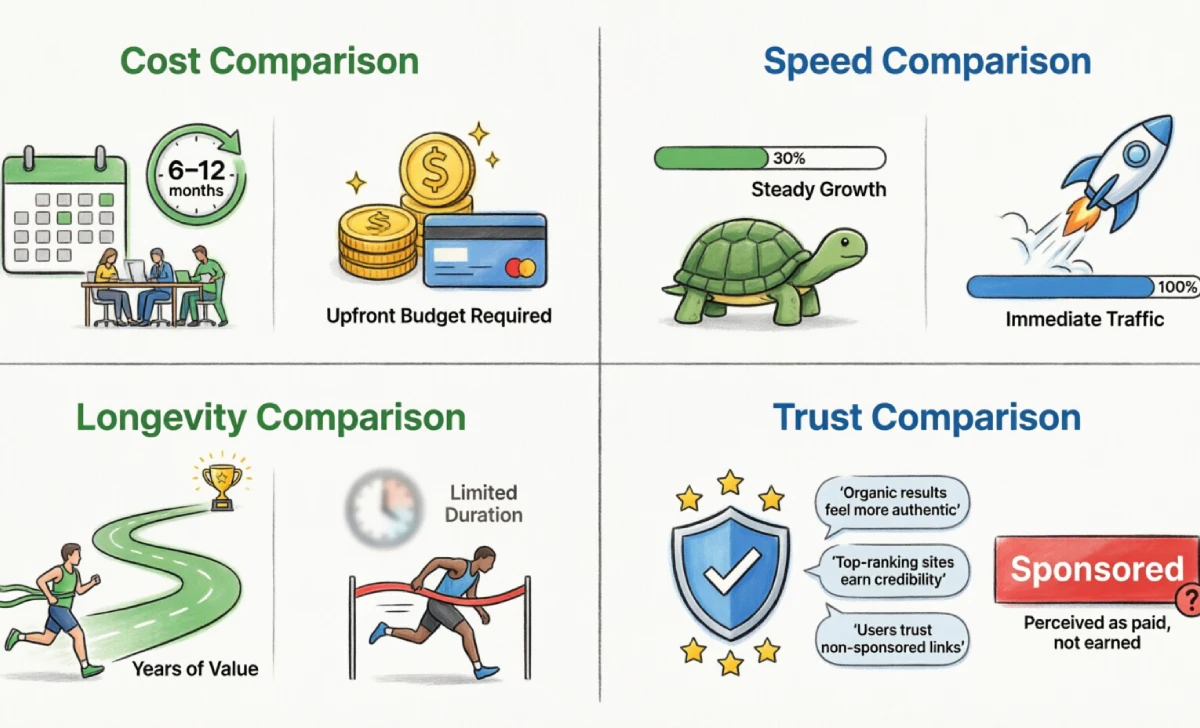
To make smart, data-driven budget decisions, you need to understand the underlying mechanics of both primary search engine marketing channels.
What is SEO?
SEO is the strategic practice of optimizing your website’s technical structure, content, and authority to rank higher in organic search results. Organic means you do not pay the search engine for these clicks; you earn them through relevance and authority.
- Technical term explained: Organic search: Unpaid website visits that come from users clicking on natural, algorithmically ranked search results.
- Best for: Building long-term brand authority, generating sustainable and compounding traffic, and answering complex user questions that build trust.
- Time to results: Typically 3 to 6 months minimum, depending on industry competition and website history.
What is PPC?
PPC is a model of paid search advertising where you bid on specific, high-intent keywords. You pay a predetermined fee each time a user actively clicks on your advertisement.
- Technical term explained: Bid: The maximum monetary amount you are willing to pay the advertising platform for a single click on your specific ad.
- Best for: Generating immediate, predictable traffic, promoting time-sensitive offers or product launches, and testing new market demographics rapidly.
- Time to results: Immediate, often within hours of campaign approval and funding.
[Visual Cue: Comparison Table] Alt-text: A side-by-side comparison table showing SEO vs PPC across cost, speed, longevity, and ideal use cases for business owners.
- Cost: SEO = Time and resource-heavy upfront; PPC = Direct monetary cost per click.
- Speed: SEO = Slow, steady build; PPC = Instant, guaranteed visibility.
- Longevity: SEO = Compounding, long-term returns; PPC = Stops immediately when funding stops.
- Trust: SEO = Higher perceived user trust and credibility; PPC = Clearly marked as “Sponsored” or “Ad.”
How to Choose the Right Strategy for Your Business
Do not guess with your marketing budget. Use this quick, actionable checklist to decide where to focus your resources first based on your current business reality:
- Do you need qualified leads this week? Choose PPC. It is the only reliable way to turn on the traffic faucet instantly.
- Is your budget extremely limited, but your time is flexible? Choose SEO. You can trade sweat equity for financial capital by creating great content and optimizing your site yourself.
- Are you launching a brand-new product with zero search history? Start with PPC to gather immediate conversion data, then build robust SEO content around the winning, proven keywords.
- Is your industry highly competitive with prohibitively expensive clicks? Invest heavily in SEO to lower your long-term customer acquisition cost and bypass the paid bidding wars.
Pro Tip: The most successful, scalable businesses do not choose just one. They use them synergistically. According to a 2025 HubSpot State of Marketing Report, companies that strategically integrate organic and paid search see a 30% higher overall conversion rate than those relying on a single channel.
Step-by-Step Framework: Launching a Combined Strategy
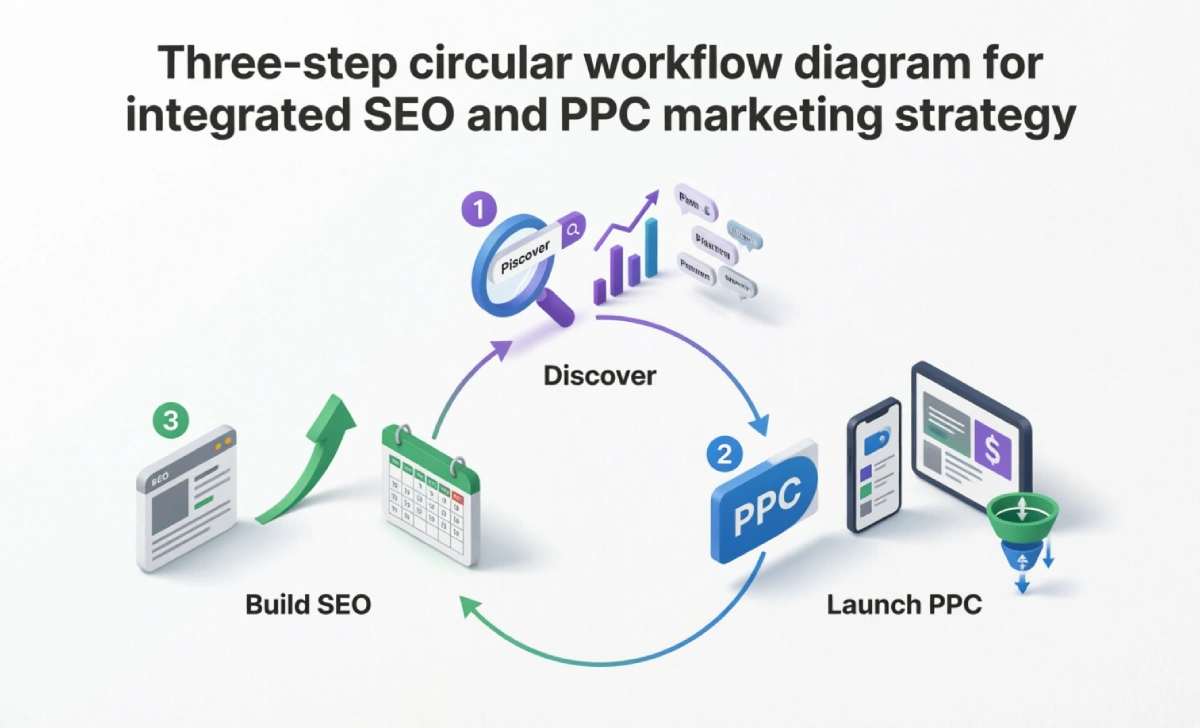
Follow this actionable, three-step framework to perfectly align your organic and paid efforts for maximum efficiency.
Step 1: Keyword Discovery and Intent Mapping. Identify exactly what your target audience is typing into search engines. Separate these keywords into “bottom-of-funnel” (ready to buy, e.g., “buy CRM software”) and “top-of-funnel” (researching, e.g., “what is CRM software”).
- Tool: Google Keyword Planner (Free) – Accurately identifies search volume, competition levels, and cost-per-click estimates for your specific target terms.
Step 2: Launch a Targeted, Lean PPC Campaign. Bid aggressively on high-intent, bottom-of-funnel keywords to capture immediate, ready-to-buy demand. This generates quick cash flow to fund your business and provides invaluable, real-world data on which keywords actually drive conversions, not just clicks.
- Tool: SEMrush or Ahrefs (Paid) – Audits site health, tracks competitor paid and organic keywords, and helps refine your bidding strategy to avoid wasted ad spend.
Step 3: Build SEO Content Around PPC Winners. Take the exact keywords that generated the highest conversion rate in your PPC campaign and create comprehensive, high-quality blog posts, guides, or landing pages targeting those same terms organically. To organize this effectively and boost your topical authority, you need to build content silos that group related topics together logically.
- Tool: Google Analytics 4 (Free) – Tracks user behavior, engagement time, and specific conversion events across both your paid and organic platforms seamlessly.
Mini-Case Study: The SaaS Startup Pivot
A B2B SaaS startup was burning $3,000/month on broad PPC keywords with a high cost-per-click and low conversion rate. Instead of abandoning paid ads, they paused the broad campaigns and shifted their budget to long-tail, high-intent keywords (e.g., “best CRM for small real estate agencies”). Simultaneously, they wrote three in-depth SEO blog posts answering the exact questions their PPC prospects were asking. Within 90 days, their PPC cost-per-acquisition dropped by 40%, and their new SEO articles began ranking on page one, capturing an additional 500 organic visitors per month at zero marginal cost. This proves the power of using paid data to fuel organic growth.
Tracking & ROI: How to Measure What Actually Matters
Vanity metrics like “impressions,” “reach,” or raw “clicks” do not pay your business bills. You must track actual revenue, cost per acquisition (CPA), and return on ad spend (ROAS). Adopt a strict Test → Measure → Optimize mindset.
- Set Up UTM Parameters: Technical term explained: UTM parameters: Simple, customizable text tags added to the end of your URLs to track exactly where your website traffic originates. Always tag your PPC ads, email campaigns, and social posts.
- Configure GA4 and Conversion Pixels: Ensure your Google Analytics 4 property is properly linked to your Google Ads account. In GA4, navigate to Admin > Events, and mark your key actions (like “generate_lead” or “purchase”) as conversions. Install conversion pixels (like the Meta Pixel) on thank-you pages to track users who click an ad but convert days later.
- A/B Test Relentlessly: Never assume your first ad copy, headline, or landing page is the absolute best. Run continuous A/B tests on headlines, calls-to-action, and page layouts. Let the hard data dictate your next strategic move, eliminating guesswork.
The Future of Search: AI, Privacy, and Ethics
The digital marketing landscape is shifting rapidly, and your strategy must adapt to stay compliant, visible, and effective in the coming years.
- AI Overviews and Search Generative Experience (SGE): Google’s ongoing integration of AI-generated summaries means fewer traditional “blue links” on the first page. To survive and thrive, your SEO content must be highly authoritative, deeply detailed, and directly answer user queries to be cited as a source in these AI snapshots. Furthermore, AI automation tools are now streamlining bid management. While efficient, human oversight remains critical to prevent AI hallucinations in ad copy, which can damage trust.
- Cookie-less Tracking: With third-party cookies phasing out globally across major browsers, you must rely on first-party data (like email sign-ups and account creations) and server-side tracking to maintain accurate ROI measurement without violating strict user privacy laws like GDPR or CCPA.
- Ethical Advertising: Always disclose sponsored content clearly and transparently. Misleading ad copy, fake reviews, or “cloaking” (showing different content to users and search engine bots) strictly violates platform Terms of Service and will result in permanent account bans. Focus relentlessly on real business value and user experience, not manipulative, short-term tricks.
Ultimately, navigating the digital marketing landscape requires a commitment to continuous learning and adaptation. Whether you are focusing on paid ads, organic optimization, or a hybrid approach, the core principles of providing value and tracking performance remain unchanged. By combining the right strategies, leveraging the right tools, and choosing to measure marketing ROI accurately, you ensure that every dollar spent contributes directly to your bottom line.
Key Takeaways
- PPC is renting; SEO is owning. Use PPC for immediate speed and SEO for sustainable, long-term brand equity.
- Combine both for maximum impact. Use your PPC conversion data to directly inform and accelerate your SEO content strategy.
- Track real ROI, not vanity metrics. Ditch superficial numbers. Use UTMs, GA4, and rigorous A/B testing to measure actual revenue and profit.
- Future-proof your strategy. Prioritize first-party data collection and high-quality, authoritative content to thrive alongside ongoing AI search updates.
Your Next Action Step
Do not let another month pass with an unbalanced, inefficient marketing budget. Pick one high-intent, bottom-of-funnel keyword today. Run a small, controlled $50 PPC test on it, and simultaneously draft one SEO-optimized landing page targeting that same phrase. Measure the results in 30 days, and let the hard data guide your next major investment.



No Comment! Be the first one.