
Your paid ads are eating up your budget, and your blog posts targeting “project management software” are stuck on page four. You’re not alone—70% of businesses report that head terms deliver traffic but few qualified leads. The antidote lives right under your nose, inside Google’s own search bar: low-competition long‑tail keywords, revealed for free by Google Autocomplete.
Why Long‑Tail Keywords Win in 2024–2026
A long‑tail keyword is a highly specific search phrase, usually three to eight words long. Think “best free inventory software for a bakery” instead of “inventory software.” In the last two years, these terms have become even more valuable.
- They capture intent with surgical precision. A HubSpot 2024 report confirmed that pages targeting long‑tail queries convert 2.5x better than generic pages.
- They’re genuinely less crowded. Ahrefs’ 2024 database analysis of over 15 billion keywords showed that 94.74% of all queries get 10 monthly searches or fewer, and the long tail makes up the majority of daily Google searches.
- AI overviews are pushing generic content aside, but answers to niche questions—especially where real human experience matters—still win clicks and featured snippets.
If you want traffic that actually turns into subscribers, leads, and customers, you must stop chasing one‑word vanity terms and start mining the long tail.
How Google Autocomplete Works (and Why It’s a Goldmine)

Google Autocomplete- those drop‑down predictions that appear as you type- isn’t a random list. According to Google’s official documentation, predictions are based on real searches, trending topics, and your location. Each suggestion is a signal: real people are already asking this exact thing. That makes Autocomplete a live focus group for content ideas.
Because these phrases often lack the commercial appeal of huge head terms, many competitors ignore them. Yet they carry transactional, informational, or navigational intent that you can satisfy immediately. The barrier to ranking is lower because the SERP (search engine results page) often includes forums, thin articles, or pages with low domain authority—a signal of low competition.
Before we dive into the method, make sure your content foundation is solid. Read our guide on building content silos to learn how to structure a page that Google loves.
Step‑by‑Step: Finding Low Competition Long‑Tail Keywords with Autocomplete
Follow this repeatable, no‑tool‑required framework. You’ll need a private/incognito browser window, so your personal search history doesn’t skew results.
1. Start with a Seed Problem or Product
Instead of broad categories, think about your customers’ specific pain points. If you sell CRM software, a seed like “small business crm” is too broad. Narrow it: “crm for solo lawyers” or “crm for wedding photographers.”
2. Mine the Predictive Text
Begin typing your seed phrase slowly in Google and pause after each word. Write down every suggestion that appears. Google will often show 4–10 predictions, depending on your device.
Example with seed: “best crm for freelance”
- best crm for freelance designers
- best crm for freelance project management
- best crm for freelance photographers free
- best crm for freelance consultants
- best crm for freelance web developers
Each of these is a potential long‑tail gem.
3. Use the Underscore Technique
Replace a word you’re curious about with an underscore (). Google fills in the blank. Type: `best for freelance designers`. You’ll see variations like “best tools,” “best apps,” “best software.” Repeat this to uncover natural language modifiers people actually use.
4. Alphabet Soup Method
After your seed phrase, add a space and the letter “a,” then “b,” then “c,” and so on. Google will reveal extensions: “best crm for freelance designers a” might trigger “…and developers,” while “b” shows “…beginners.” This simple trick often surfaces needs you would never brainstorm on your own.
5. Hijack “People Also Ask” and Related Searches
Scroll halfway down the results page. The “People also ask” box is a treasure chest of question‑based long‑tail keywords. Grab every question that matches your expertise. Then scroll to the bottom of the page for the “Related searches” section—Google is literally handing you eight more keyword ideas that searchers explore next.
Visual Placeholder: Comparison Table
(Insert a comparison table here that contrasts manual Autocomplete mining vs. paid tools. Alt‑text: “Table comparing free Google Autocomplete method, free tool AlsoAsked, and paid tool Semrush for discovering low-competition long-tail keywords.”)
Filtering for True Low Competition (Tools & Metrics)
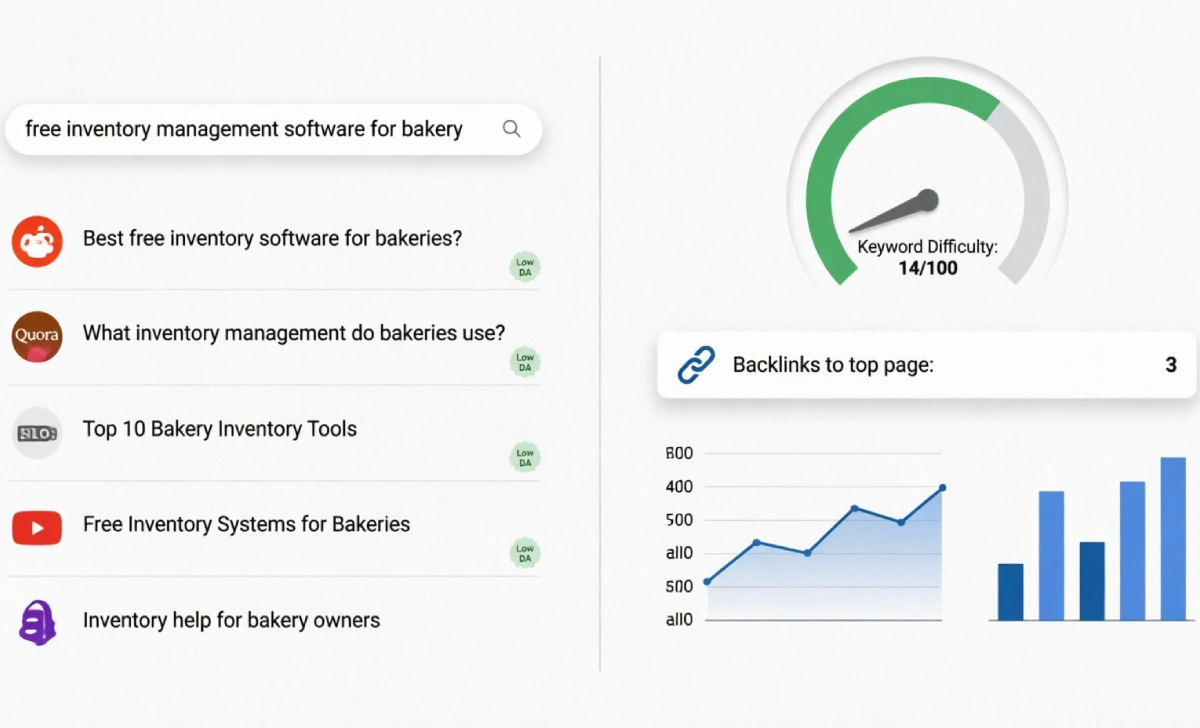
Finding the phrase is just half the battle. You must validate that you can actually rank.
- Check the SERP manually. Look at the top five results. If they’re Reddit threads, Quora, or small niche blogs, that’s a green flag. If established giants like Forbes or Gartner dominate, the keyword might be harder than it looks.
- Use a free tool like Google Keyword Planner (inside your Google Ads account) to see approximate monthly search volume. Even 10–50 searches a month can be gold if the intent is commercial.
- Leverage AlsoAsked.com (free tier available) to extract “People also ask” data visually, revealing clustered topics you can cover in one post.
- Paid alternative: Semrush or Ahrefs. Run the keyword through their keyword difficulty tool. For low competition, look for a difficulty score under 20 (on a 0–100 scale). Ahrefs also shows you how many backlinks the current top‑ranking pages have—if the #1 result has only two referring domains, you can compete.
Mini case study: A SaaS startup targeting “free inventory management software for small bakery” found via the alphabet method ranked #3 in four months. The top results were a YouTube video and a low‑authority blog. That single page now drives 400 organic visits a month and 15 trial sign‑ups. No paid ads, no massive domain authority required.
Turning Keywords into Content That Ranks
Possessing a list of low-competition long‑tail keywords is useless without content that matches search intent.
- Informational queries (“how to set up a home office for video calls”) need a detailed guide, not a product page.
- Commercial investigation (“best noise‑canceling headset under $100 for remote work”) deserves a comparison table, real‑world test notes, and honest pros/cons.
- Transactional terms (“buy noise‑canceling headset with mic online”) need a streamlined purchase flow.
Write in the same language your audience uses. If the keyword is “quick vegan breakfast ideas for kids no eggs,” don’t write a generic post about “plant‑based nutrition.” Acknowledge the urgency (“quick”), the audience (“kids”), and the exclusion (“no eggs”) right in your heading, meta description, and opening paragraph. That signals relevance to Google’s Helpful Content System, which in 2024–2025 continues to reward people‑first content that satisfies a specific need.
Once your content is live, tie it into your broader strategy. Check out our guide on how to rank without backlinks to measure your progress and discover additional opportunities.
Measuring Success: KPIs and Tracking
You can’t improve what you don’t measure. Set up a lightweight tracking system from day one.
- Primary KPIs: Organic keyword rankings (tracked in Google Search Console or a rank tracker like SERPWatcher), organic clicks, and conversion events (form submissions, purchases, sign‑ups).
- Tracking setup: Use UTM parameters when promoting the page via email or social. In GA4, create a custom event for “time on page > 3 minutes” or “scroll depth 75%” to gauge content quality. Ensure your pixel or server‑side tracking is configured so you can attribute leads to the exact long‑tail landing page.
- Test → Measure → Optimize mindset: Don’t guess. If a keyword ranks on page two but gets zero clicks, A/B test your title tag and meta description. A 2025 Semrush experiment showed that adding the year or a number to a headline lifted click‑through rate by 12–18% for long‑tail queries. Run the test, let data decide, and push the winner.
Future‑Proofing Your Keyword Strategy
Search is changing fast, but low-competition long‑tail keywords remain resilient.
- AI overviews (SGE): Google’s AI summaries may answer a simple question immediately, yet research shows that complex, multi‑step queries—the exact type you find with Autocomplete—still generate clicks because users want deeper expertise, community opinions, or step‑by‑step walkthroughs. Optimize for “how to” and “vs.” queries, and include original diagrams, real‑world data, and expert quotes that AI cannot fabricate.
- Cookie‑less reality: As third‑party cookies fade, the value of intent‑rich search keywords increases. When you attract someone who searched “best tax accountant for freelancers in Austin,” you don’t need to stalk them with a cookie—they’ve already told you exactly what they want. First‑party data collected through a lead magnet or gated content attached to that page becomes your most ethical and effective marketing asset.
- Compliance and TOS: Google’s terms forbid automated scraping of Autocomplete. Manual research—typing keywords yourself—is perfectly compliant. Respect the platform, and never use bots to harvest predictions.
- No overpromising: Ranking for a long‑tail keyword doesn’t guarantee a flood of traffic. What it guarantees is relevance and a higher probability of conversion. To track the payoff, learn how to measure digital marketing ROI from every long‑tail piece. Build a portfolio of 20–50 such pages, and the compounded, targeted traffic becomes a reliable growth engine without the volatility of algorithm storms.
Conclusion
Google Autocomplete turns your own curiosity into a competitive advantage. Instead of guessing what your audience wants, you’re listening directly to their exact questions—and then building content that answers them better than anyone else. Start your next content sprint by opening an incognito window, typing one seed phrase, and pulling five long‑tail gems. The combination of low competition, clear intent, and real human language makes these keywords your fastest path to consistent organic growth, no matter how many AI‑powered changes the search landscape throws at you.






No Comment! Be the first one.