Imagine scrolling through your feed and finding a video of yourself saying things you never said. You didn’t record it. You didn’t approve it. An AI model made it, using your face as raw material.
This scenario is no longer rare. As AI video and image tools have improved, so has the ease of generating a convincing likeness of almost anyone. In response, platforms and vendors have built a new category of tool: AI likeness detection.
This guide explains what these tools are, how they work, and which ones stand out in 2026. You’ll find a full comparison table, a breakdown of use cases, an honest look at accuracy limits, and guidance on choosing the right tool for your situation.
What Is AI Likeness Detection?
AI likeness detection is a technology that scans content to find unauthorised use of a person’s face, voice, or identity in AI-generated material. It’s different from general AI image detection, which simply asks “was this made by AI?” Likeness detection asks a more specific question: “does this AI-generated content resemble a real, identifiable person?”
That distinction matters. An AI-generated landscape photo raises no likeness concerns. An AI-generated video of a real person doing or saying something they never did is a different problem entirely, one tied to consent, reputation, and identity.
Two major platforms have moved first on this front. YouTube rolled out a likeness detection tool that works something like Content ID, but for faces instead of copyrighted audio. TikTok followed with its own opt-in version. On July 17, 2026, TikTok confirmed it was testing a Likeness Detection tool with a small group of US creators, letting them flag AI-generated content that uses their face without permission.
How AI Likeness Detection Works
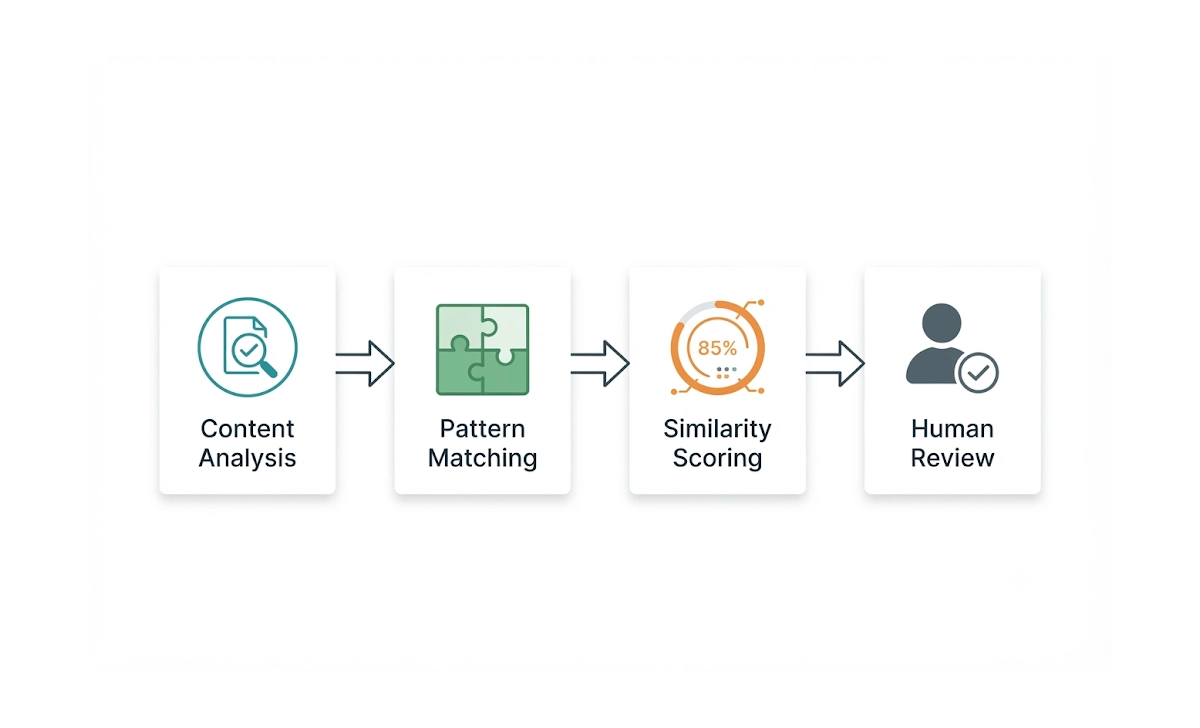
Most likeness detection tools follow a similar process, even though the underlying technology varies by vendor.
1. Content analysis. The tool scans an image or video and pulls out visual signals: facial structure, distinctive features, and in some cases, subtle patterns left behind by the generation process itself, like unnatural smoothness or repeating textures.
2. Pattern matching. The system compares what it finds against a reference set. That could be a database of known faces (for platform tools verifying a creator’s identity) or a library of protected characters, celebrities, and brands (for enterprise tools like Higgsfield’s).
3. Similarity scoring. Rather than a flat yes-or-no answer, most tools return a percentage-based score showing how strong the match is. A higher score means a stronger likely match.
4. Human review. The final step usually involves a person. TikTok’s tool surfaces potential matches for the creator to review before they report anything. Higgsfield’s tool flags a similarity so a production team can decide what to do before finishing a project.
Under the hood, this typically relies on image embeddings (numerical representations of visual features) and classification models that output a confidence score. It sounds precise, but it’s worth being clear-eyed here: most AI image detectors perform no better than a coin toss, according to independent testing. Accuracy depends heavily on which AI generators the tool was trained to recognise, how recent those generators are, and whether the test image has been resized or compressed.
What Detectors Actually Look For
Different tools focus on different categories of likeness, and it helps to know which one applies to your situation:
- Actor and celebrity likeness — a real, identifiable public figure appearing in AI-generated content.
- Brand and trademark elements — logos, taglines, or other protected brand assets showing up inside generated images.
- Fictional characters — copyrighted characters recreated through AI tools.
- General resemblance to a real person — content that closely mirrors someone’s face or features without naming them directly.
- Biometric signals — deeper facial structure analysis used mainly by identity verification and platform tools.
On the technical side, detectors typically look for repeating textures, unnaturally smooth skin or backgrounds, small pixel-level inconsistencies, and other generation artefacts left behind by diffusion models or GANs (Generative Adversarial Networks). Some newer tools also check for embedded watermark data, such as C2PA or IPTC metadata, which certain AI generators attach automatically to flag synthetic origin.
AI Image Detection vs. Likeness Detection
These two terms get used interchangeably, but they answer different questions. AI image detection asks whether content was generated by AI at all. Likeness detection goes a step further and asks whether that AI-generated content resembles a specific, real, identifiable person. A tool can correctly flag an image as AI-generated while still missing the more sensitive question of whose face it’s using.
Top AI Likeness Detection Tools in 2026
Platform-Native Tools
TikTok Likeness Detection: An opt-in tool currently being tested with a small group of US creators. To use it, a creator must first verify their identity through Jumio, which involves a real-time selfie and an ID check. According to TikTok US spokesperson Zachary Kizer, the company does not keep ID documents; facial data is used only to match a creator’s likeness against AI-generated content that may be using it without consent.
YouTube Likeness Detection Available to eligible creators over 18, and later extended to celebrities and talent agencies. It works in a similar way to Content ID, scanning uploaded videos for matches against a creator’s registered likeness and giving them tools to report or request removal.
Third-Party APIs and Tools
Hive Likeness Detection AP: A cloud-based API built to identify popular characters, celebrities, and artwork inside images. Hive processes billions of API calls per month, making it one of the larger players serving enterprise content moderation and IP protection.
Higgsfield Similarity Scoring Launched March 13, 2026, for Higgsfield’s Team Plan customers, this tool evaluates AI-generated video and images and flags similarities to characters, celebrities, brand logos, artworks, and even distinct directorial styles. In internal benchmark testing, Higgsfield’s model reached an 86.6% overall accuracy rate in video detection, compared to 48.5% for a leading third-party alternative, with a false positive rate of 13.3% versus 73.8% for that alternative. Since launch, Higgsfield says its user base has grown roughly 100x.
Sightengine:ne An image moderation API that detects AI-generated content from tools like Midjourney and DALL-E, spanning more than 110 moderation categories beyond just likeness.
Winston AI Detects images produced by tools such as Nano Banana, ChatGPT, Midjourney, Grok, and Stable Diffusion. It also checks for C2PA and IPTC watermark data, which some AI generators embed to signal synthetic origin.
AI or Not: A straightforward, synchronous detection endpoint, often used for lightweight or educational integrations rather than enterprise-scale moderation.
Reality Defender: Focused specifically on deepfake and face detection, with a public free tier available for smaller-scale testing.
Loti: AI: A consumer-facing digital identity protection platform. Rather than a one-time check, it continuously scans the internet for a person’s face and voice, and helps them request removal of unauthorised deepfakes.
Decopy AI is trained to recognise output from Midjourney, Stable Diffusion, DALL-E, and Flux.
AI Likeness Detection Tools Comparison Table
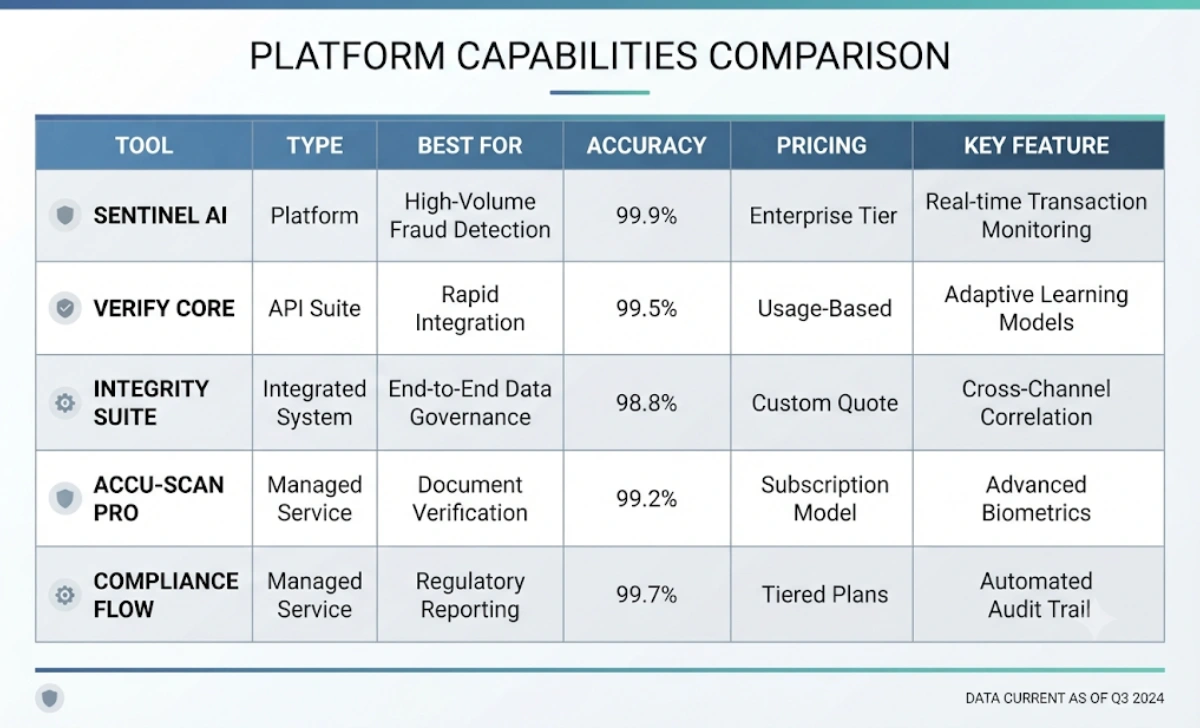
| Tool | Type | Best For | Reported Accuracy | Pricing | Key Feature |
|---|---|---|---|---|---|
| TikTok Likeness Detection | Platform-native | TikTok creators | Not published | Free (opt-in) | Jumio identity verification |
| YouTube Likeness Detection | Platform-native | YouTube creators, talent agencies | Not published | Free | Content ID-style matching |
| Hive Likeness Detection API | Enterprise API | IP protection, content moderation | Not published | Enterprise (sales-led) | Handles billions of calls monthly |
| Higgsfield Similarity Scoring | Enterprise API | Production teams | 86.6% (video) | Team Plan | Multi-category detection, including audio |
| Sightengine | API | General image moderation | Varies | Self-serve | 110+ moderation categories |
| Reality Defender | API | Deepfake and face detection | Varies | Free tier + paid | Specialises in faces |
| Winston AI | API/extension | General users | Varies | Freemium | Watermark (C2PA/IPTC) detection |
| Loti AI | Consumer platform | Personal digital identity | Not published | Subscription | Continuous internet scanning |
Use Cases & Applications
Creators and public figures. The most direct use case. TikTok and YouTube now give individual creators a way to find and report unauthorised deepfakes of themselves, without needing legal help or technical skill to spot the problem in the first place.
Entertainment and media companies. Studios and talent agencies use likeness detection to catch AI-generated content that infringes on an actor’s or artist’s image before it spreads widely, giving them a chance to act while the exposure is still limited.
Digital platforms and marketplaces. Content moderation teams use these tools to screen user-generated uploads for unauthorised use of protected characters, brands, or real people, reducing the amount of infringing material that reaches a wide audience.
AI developers. Some teams use likeness detection during model training to filter out protected characters or real faces from datasets, reducing legal and ethical risk before a model ever ships.
News and journalism. Verifying whether an image is authentic or AI-generated has become part of basic fact-checking, especially around breaking news events, elections, and other moments where a convincing fake image can spread faster than a correction.
Dating apps and identity verification services. Detecting AI-generated faces helps prevent fake profiles built entirely from synthetic images, a growing problem as image generators produce more convincing headshots.
Brands. Companies use these tools to catch unauthorised use of logos and trademarks appearing inside AI-generated images and video, particularly as more marketing content gets produced with AI tools at speed.
Accuracy & Limitations
It’s worth stating plainly: detection accuracy is uneven across the industry. Independent tests have found that many AI image detectors perform no better than random guessing. Even where vendors publish strong numbers, like Higgsfield’s 86.6% figure, those results come from internal testing against the company’s own benchmark, not necessarily an independent third party.
A few things affect how well any given tool performs:
- Generator coverage. A detector trained to recognise output from Midjourney may struggle with content from a newer or less common model.
- Image compression and resizing. Common web and social media compression can strip away the subtle signals a detector relies on.
- False positives versus false negatives. A false positive, wrongly flagging a real photo as AI-generated, can be more damaging than a missed detection, since it can wrongly accuse a real person of fraud or impersonation.
- The moving target problem. Detection tools are built against known generation methods. As new generative models launch, older detectors can fall behind.
The most useful mindset here: treat a similarity score as one signal among several, not a final verdict.
This isn’t a small caveat. In one independent round of testing covering ten different AI detection tools, only three correctly identified an image as AI-generated. That kind of gap between marketing claims and real-world performance is common across the industry, not unique to any single vendor. It’s also worth remembering that generative models keep improving. AI-generated images of familiar faces are increasingly hard to tell apart from real photographs, even for a careful human observer, which puts more pressure on detection tools to keep pace. When a detector’s training data lags behind the newest generation methods, its accuracy on fresh content can drop sharply, even if it performed well in a vendor’s original benchmark.
How to Choose the Right AI Likeness Detection Tool
| If you are… | Best tool type | Consider |
|---|---|---|
| A creator on TikTok or YouTube | Platform-native | Built-in TikTok or YouTube tools |
| An enterprise protecting IP | Enterprise API | Hive, Higgsfield |
| A developer building an app | Self-serve API | Sightengine, Reality Defender, AI or Not |
| Focused on personal digital identity | Consumer platform | Loti AI |
| A journalist verifying images | Multiple tools | Cross-check results across 2–3 tools |
When comparing options, weigh:
- Accuracy claims. Ask what dataset produced the published number, and test the tool yourself where possible.
- Cost of being wrong. Decide whether a false positive or a false negative would hurt more in your context.
- Speed. A detection call that takes 200 milliseconds fits a different workflow than one that takes several seconds.
- Generator coverage. Confirm the tool actually detects the AI models relevant to your use case.
- Integration effort. Some tools offer a single API call; others require a more involved setup.
- Data handling. Check whether the tool stores your images or biometric data, or processes everything locally.
Privacy & Ethical Considerations
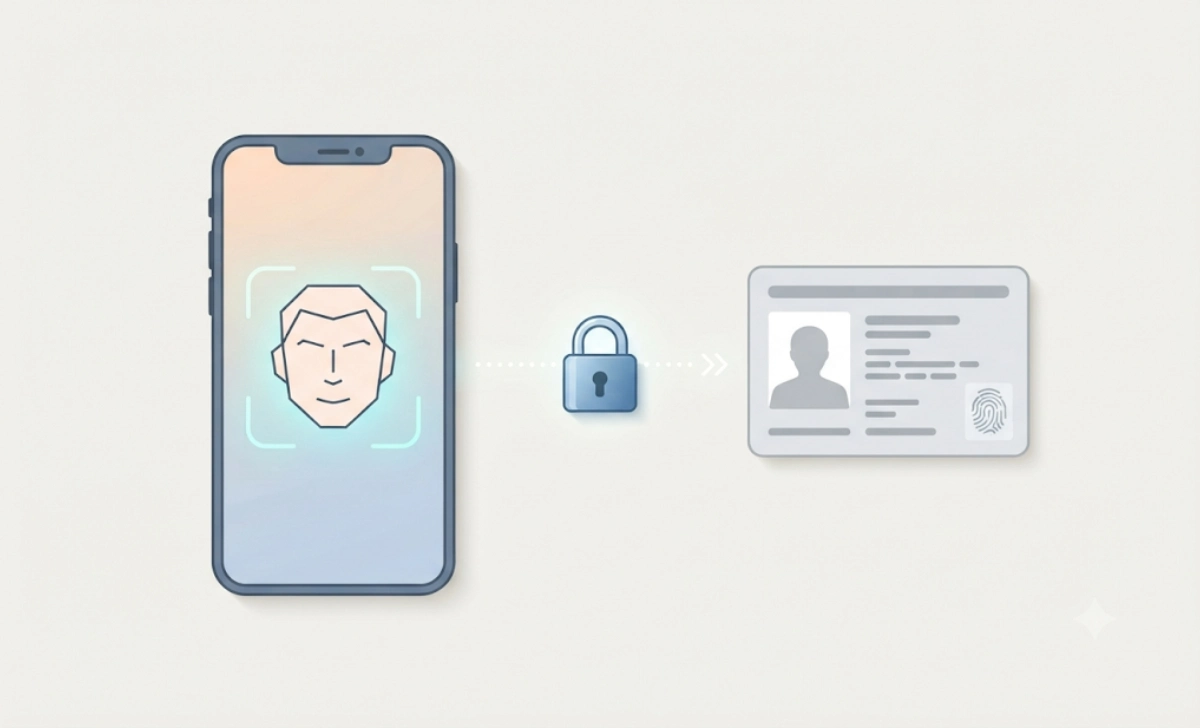
There’s a built-in tension in this technology: to protect your likeness from misuse, you often have to hand over sensitive biometric data first.
TikTok’s approach illustrates the tradeoff. Creators who want to use its Likeness Detection tool must first verify their identity through Jumio, submitting a real-time selfie and an ID check. TikTok says it does not retain ID documents, and facial data is used only for likeness matching, not stored for other purposes. Still, the requirement means creators are trading one form of exposure (submitting biometric data to a platform) to reduce another (unauthorised AI likenesses circulating online).
Data handling varies by vendor. Some tools process everything locally without sending images to a server. Others operate as cloud-based APIs, meaning your content passes through third-party infrastructure. Before adopting any tool, it’s worth checking exactly what happens to the images or video you submit, and how long that data is kept.
There’s also a broader, unresolved question sitting underneath all of this: who actually owns a person’s digital likeness, and what does meaningful consent look like in a world where anyone’s face can become training material?
The Future of AI Likeness Detection
Likeness detection is moving from a niche feature to something creators expect as standard. YouTube and TikTok have effectively set a new baseline, and other platforms are likely to follow.
A few trends worth watching:
- Platform competition. Whichever platform builds the most accurate, least intrusive detection system stands to gain real trust with creators, a meaningful edge in the broader creator economy.
- Expansion beyond creators. YouTube has already extended likeness protections to celebrities and talent agencies, not just individual creators, suggesting the scope will keep widening.
- Better detection methods. Research continues into embedding-based detection and hybrid approaches that combine traditional forensic analysis with newer deep learning techniques.
- Convergence with identity verification. As platforms lean more on services like Jumio, likeness detection is becoming intertwined with broader identity verification infrastructure, for better or worse.
Conclusion
AI likeness detection has moved quickly from an experimental idea to a feature creators expect from major platforms. TikTok’s and YouTube’s built-in tools give individuals a direct way to protect their identity, while enterprise APIs like Hive, Higgsfield, and Sightengine give businesses and developers a way to check content at scale.
None of these tools is foolproof. Accuracy still varies a great deal, and the technology is racing to keep pace with new AI generation models. The most practical approach is to treat any similarity score as one useful signal, not a guaranteed answer, and to choose a tool that matches your specific need, whether that’s personal protection, enterprise IP compliance, or building detection into your own product.
This is a fast-moving space. Expect tool lineups, pricing, and accuracy claims to shift over the coming months as more platforms roll out their own versions.
FAQs
What is an AI likeness detection tool?
It’s a tool that scans content for unauthorised use of a real person’s face, voice, or identity in AI-generated material, typically using pattern matching and similarity scoring.
How does AI likeness detection work?
It analyses an image or video, compares it against a reference database, calculates a similarity score, and in most cases surfaces the result for human review before any action is taken.
Is TikTok testing an AI likeness detection tool?
Yes. As of July 17, 2026, TikTok confirmed it is testing an opt-in Likeness Detection tool with a small group of US creators, letting them find and report AI-generated content using their face without consent.
Does YouTube have a likeness detection tool?
Yes. YouTube’s tool is available to eligible creators over 18 and has been extended to celebrities and talent agencies as well.
Are AI likeness detection tools accurate?
Accuracy varies widely by tool. Some vendors publish strong internal numbers, like Higgsfield’s 86.6% video detection accuracy, but independent testing has found that many detectors on the market perform no better than a coin toss. Treat any result as a signal, not a final answer.
What’s the best AI likeness detection tool?
It depends on your situation. Creators are best served by TikTok’s or YouTube’s built-in tools. Enterprises protecting IP at scale tend to look at Hive or Higgsfield. Developers building their own applications often reach for self-serve APIs like Sightengine or Reality Defender.
How much do AI likeness detection tools cost?
Costs range from free, for TikTok, YouTube, and some free API tiers, up to enterprise pricing for tools like Hive and Higgsfield’s Team Plan.
Can I detect AI-generated images for free?
Yes. Several tools offer free tiers or free usage, including Reality Defender and various open detection models.

Other Articles


No Comment! Be the first one.