
Choose a pool shape based on your home’s architecture: geometric pools with straight lines suit modern and traditional homes, while freeform pools with curved edges suit Mediterranean, coastal, and tropical styles. Also weigh your backyard’s size, how you’ll use the pool, your budget, and long-term maintenance before deciding.
A pool is one of the few home upgrades you’ll live with for decades, and the shape you pick either pulls your whole property together or fights with it every time you look out the window. Homeowners often start pool planning by browsing photos of the most striking designs they can find, then work backwards to make one fit. That order tends to produce a pool that looks great in isolation but feels out of place next to the house.
The better approach starts with your home. A Spanish colonial with arched doorways and terracotta roofing calls for different lines than a glass-and-steel modern build. Getting this right from the beginning saves you from a costly redesign, and it’s the difference between a backyard that looks planned and one that looks added on.
This guide covers how to choose a pool shape based on your home’s architecture, your backyard’s size, and how your family actually plans to use the space. You’ll find comparisons between geometric and freeform pools, shape recommendations by home style, and the design details that tie a pool to the rest of your property.
Why Pool Shape Matters More Than You Think
The Connection Between Architecture and Pool Design
Buildings and landscapes read as a single composition when their lines agree with each other. A home with straight rooflines, square windows, and clean facades sets a visual language, and a pool with sharp geometric edges speaks that same language. A home with curved archways, stucco walls, and rounded details calls for a pool with softer, more organic lines.
This isn’t a rigid rule, but ignoring it usually shows. A perfectly circular pool next to a boxy modern home can look like it belongs to a different property entirely. Matching pool shape to architectural style keeps the eye moving smoothly from house to yard instead of catching on a mismatch.
How the Right Pool Shape Enhances Your Outdoor Living Space
A pool shape does more than sit there and hold water. It shapes how you walk through your backyard, where you place seating, and how much usable deck space you have left over. A long rectangular pool creates a clear sightline down its length, which works well for backyards that are narrow and deep. A kidney-shaped pool curves around a patio or garden bed, creating separate zones for swimming and lounging without needing a fence or wall.
Get the shape right, and the pool becomes the anchor that the rest of your outdoor space is built around, rather than an obstacle you design around.
Benefits of Choosing the Right Pool Shape
Picking a shape that fits your home and yard pays off in a few concrete ways:
- Visual cohesion. The property looks intentional, not like two separate design decisions stitched together.
- Better use of space. A shape suited to your yard’s dimensions leaves more usable deck and lawn area.
- Easier resale. Buyers respond better to a pool that looks like it was planned with the house in mind.
- Lower friction with lifestyle needs. A shape matched to how you’ll actually use the pool, whether that’s laps, entertaining, or relaxing, reduces regret after installation.
Key Factors to Consider Before Choosing a Pool Shape
Your Home’s Architectural Style
Start here. Modern homes tend to pair well with clean geometric shapes. Mediterranean and Spanish-style homes often suit curved, freeform designs or classic Roman pools. Traditional and colonial homes lean toward symmetrical shapes like rectangles or Grecian pools. This isn’t about forcing your home into a category; it’s about noticing the lines your house already has and choosing a shape that agrees with them.
Backyard Size and Layout
A pool shape that looks great in a photo can be the wrong choice for your actual lot. Long rectangular pools need length. Freeform pools with wide curves need width. Small or oddly shaped backyards usually do better with a compact geometric pool or a custom design built to the exact dimensions available, rather than trying to squeeze a standard shape into a space it wasn’t meant for.
Lifestyle and Pool Usage
Think about how the pool will actually get used. A family with young kids benefits from a shallow tanning ledge and gradual entry, which many freeform and lagoon-style pools include. A swimmer who wants laps needs a straight, uninterrupted run, which points toward a rectangular design. Someone who plans to host guests often wants a pool with a spa attached and open deck space for seating.
Budget and Construction Costs
Geometric pools with straight lines are generally simpler and less costly to build than freeform pools, since curved forms require more custom formwork and labour. That said, the difference varies by builder, region, and the complexity of the specific design, so get quotes based on your actual site rather than assuming one shape category is always cheaper.
Long-Term Maintenance Requirements
Pool shape affects more than looks. Pools with more corners and edges, including some freeform and figure-eight designs, can be more time-consuming to clean and may need more attention to water circulation in tight spots. Simpler geometric shapes tend to have more even water flow, which can mean less manual work over time.
Geometric vs. Freeform Pools: Which Is Right for You?
What Is a Geometric Pool?
A geometric pool uses straight lines and defined angles, such as rectangles, squares, ovals, and L-shapes. These designs have clear symmetry and a formal, structured look.
Advantages
- Straightforward to plan and typically faster to build
- Easier to fit standard pool covers and equipment
- Simple to clean thanks to consistent depth and shape
- Pairs naturally with formal landscaping and hardscaping
Best Home Styles
Modern, contemporary, traditional, and colonial homes tend to suit geometric pools best, since their straight architectural lines carry through to the yard.
What Is a Freeform Pool?
A freeform pool uses curved, irregular lines instead of straight edges. Kidney shapes, lagoon pools, and fully custom organic designs fall into this category. They’re built to feel like a natural water feature rather than a structured element.
Advantages
- Blends well with lush or naturalistic landscaping
- Can be shaped around existing trees, slopes, or garden beds
- Often includes varied depths and features like tanning ledges or waterfalls
- Feels less formal and more relaxed
Best Home Styles
Mediterranean, Spanish-style, coastal, and tropical homes generally suit freeform pools, since their softer architectural lines match the pool’s curves.
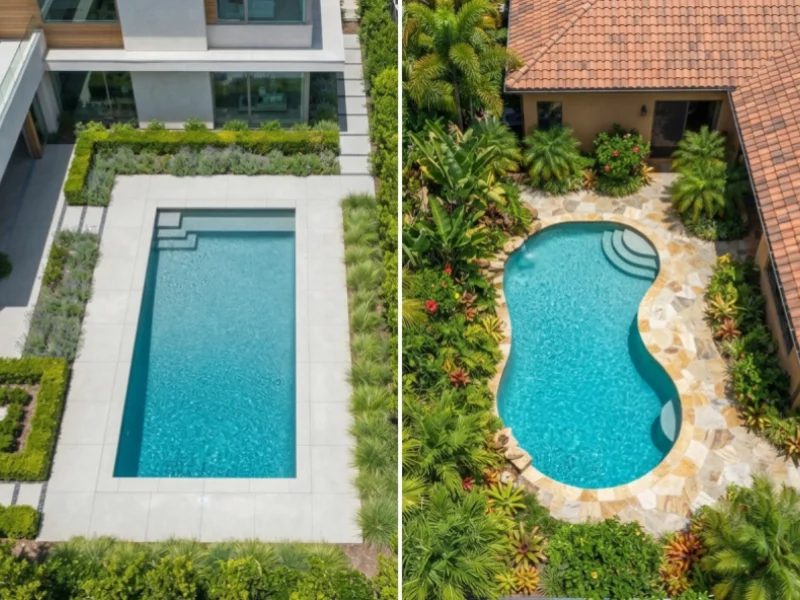
Geometric vs. Freeform Comparison Table
| Feature | Geometric Pools | Freeform Pools |
|---|---|---|
| Visual style | Structured, formal | Natural, relaxed |
| Best for | Modern, traditional homes | Mediterranean, coastal homes |
| Construction complexity | Lower to moderate | Moderate to higher |
| Typical cost | Often lower | Often higher |
| Maintenance | Generally simpler | Can require more attention |
| Landscaping pairing | Formal, symmetrical plantings | Naturalistic, layered plantings |
Best Pool Shapes for Different Home Styles
Modern and Contemporary Homes
Rectangular Pools: ls The clean lines of a rectangular pool echo the flat rooflines and large glass panels common in modern architecture. This shape also works well with minimalist decking in concrete or wood.
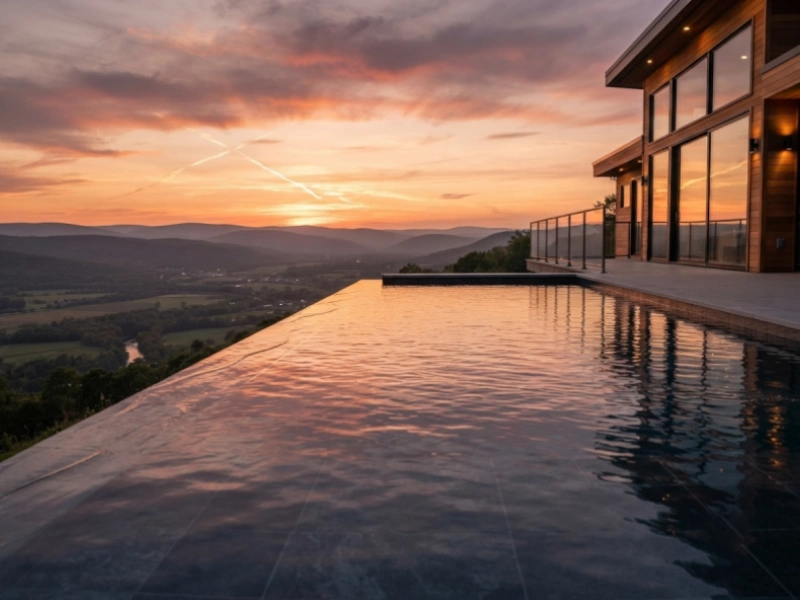
Infinity Pools: For homes on a slope or with a view worth showing off, an infinity edge extends the architectural language of glass and open sightlines right into the water.
Mediterranean and Spanish-Style Homes
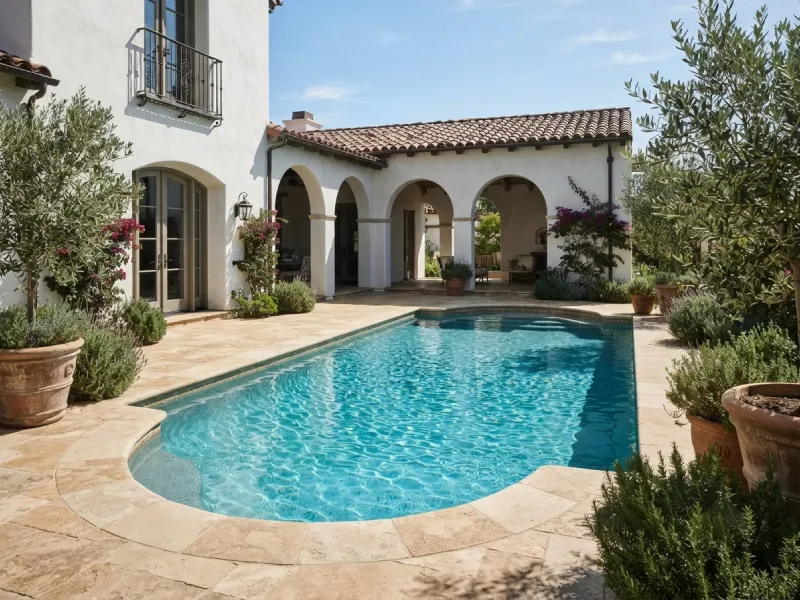
Roman Pools:ols A Roman pool combines a rectangular base with rounded ends, giving it just enough curve to soften a formal shape without breaking from tradition. It suits homes with arched windows and doorways.
Freeform Pools: For a more relaxed Mediterranean feel, freeform designs paired with stone decking and Mediterranean plantings echo the organic textures common to this style.
Traditional and Colonial Homes
Grecian Pools:s A Grecian pool is a rectangle with clipped corners, giving it a classic, formal look that fits symmetrical colonial facades and manicured landscaping.
Rectangular Pools: A straightforward rectangle also works well here, particularly when paired with a formal patio layout and evenly spaced plantings.
Ranch and Craftsman Homes
Kidney-Shaped Pools:s The relaxed, low-slung profile of ranch and craftsman homes pairs naturally with the soft curves of a kidney pool, especially in yards with informal, garden-style landscaping.
L-Shaped Pools: ls An L-shaped design lets you separate a shallow play area from a deeper swimming zone, which suits the practical, family-oriented layout many ranch homes are built around.
Coastal and Tropical Homes
Lagoon Pools:ols Lagoon pools mimic natural bodies of water with irregular edges and shallow entry points, which fits coastal properties aiming for a beach-like feel.
Organic Freeform Pools: Paired with tropical plantings and natural stone, a fully custom freeform pool completes the relaxed, resort-style look many coastal and tropical homes are going for.
Popular Pool Shapes Explained
Rectangular Pools
The most common shape for a reason: straightforward to build, easy to fit lap lanes into, and flexible enough to suit almost any architectural style with the right finishing details.
Kidney-Shaped Pools
A curved, asymmetrical shape with one narrow end and one wide end. Popular for its soft lines and ability to wrap around existing patio space.
Roman Pools
A rectangle with rounded or squared-off ends, often built with steps along one edge. Blends formal structure with a slightly softer look.
Grecian Pools
A rectangle with angled, clipped corners. Adds visual interest to a formal shape without the cost of a full custom design.
L-Shaped Pools
Two connected rectangular sections at an angle, useful for separating a shallow area from a deep end or creating distinct zones for kids and adults.
Figure-Eight Pools
Two connected circular or oval sections. Distinctive, but can be harder to clean and heat evenly due to the narrow connecting point.
Lagoon Pools
Irregular, natural-looking edges meant to resemble a body of water in nature. Often built with a gradual, beach-style entry.
Infinity Edge Pools
One or more edges appear to disappear into the horizon, created by water flowing over a lowered edge into a catch basin. Best suited to sloped lots with a view.
Cocktail and Plunge Pools
Small, compact pools meant for cooling off and lounging rather than swimming laps. A good fit for small backyards or as a secondary water feature.
Fully Custom Pool Designs
Built entirely around your yard’s dimensions, existing landscaping, and personal preferences. Costs more and takes longer to plan, but removes the limitations of a standard shape.
Choosing a Pool Shape Based on Lifestyle
Best Pool Shapes for Families
L-shaped and freeform pools with a shallow tanning ledge or beach entry give young children a safe, gradual way into the water while still leaving room for older kids and adults to swim.
Best Pool Shapes for Entertaining Guests
Rectangular and Roman pools with attached spas and wide deck areas give guests room to move between the water, seating, and any outdoor kitchen or bar setup.
Best Pool Shapes for Fitness and Lap Swimming
A long, narrow rectangular pool with no interruptions along its length is the clearest choice here. Anything under roughly 30 feet limits how effective lap swimming feels.
Best Pool Shapes for Relaxation and Luxury Living
Freeform and lagoon pools with waterfalls, tanning ledges, and layered landscaping create a resort feel that prioritises atmosphere over structured swimming.
Design Features That Complement Your Pool
Built-In Spas
A spa attached to the pool, whether raised or flush, adds a warm-water option for cooler months and extends how often the space gets used.
Tanning Ledges
A shallow, submerged shelf near the pool’s edge for lounging in a few inches of water. Common in freeform and lagoon designs, and increasingly popular in geometric pools too.
Infinity Edges
Beyond the visual effect, an infinity edge requires a catch basin and additional plumbing, which adds to both cost and long-term maintenance.
Waterfalls and Rock Features
Add both sound and movement to a pool. These pair especially well with freeform designs and naturalistic landscaping.
Lighting Design
LED lighting built into the pool shell lets you change colour and mood, and it also improves safety for evening swims.
Decking and Hardscaping
Material choice, whether concrete, natural stone, or wood-look composite, should echo materials already used on the home’s exterior for a consistent look.
Landscaping That Matches Your Pool Style
Formal, trimmed plantings suit geometric pools. Layered, textured plantings with ornamental grasses or tropical foliage suit freeform designs.
Common Mistakes to Avoid When Choosing a Pool Shape
Ignoring Your Home’s Architecture
Choosing a shape purely from inspiration photos, without considering how it will sit next to your actual home, is the most common reason pools end up looking disconnected from the property.
Choosing Style Over Function
A stunning shape that doesn’t support how you actually plan to use the pool, whether that’s swimming laps or supervising young kids, leads to regret once construction is finished.
Overlooking Future Maintenance
Complex shapes with tight corners and varied depths can mean more time spent on cleaning and water balancing. Factor this in before committing to an intricate design.
Not Planning for Backyard Flow
A pool placed without considering how people will walk around it, where furniture will go, and how it connects to the house can leave the rest of the yard feeling cramped or awkward.
Forgetting About Property Value
An unusual or highly personalised shape might suit your taste perfectly but appeal to a smaller pool of future buyers. If resale is a consideration, lean toward shapes with broader appeal.
How to Work with a Pool Designer
Questions to Ask Before Building
Ask about typical timelines for your chosen shape, how the design will handle your yard’s slope or soil conditions, what maintenance the shape will require, and how the quote breaks down between excavation, materials, and finishing work.
Planning a Custom Pool That Fits Your Home
Bring photos of your home’s exterior and any inspiration images to your first meeting with a designer. A good designer will translate those references into a shape that works with your yard’s actual dimensions, not just a copy of the inspiration photo.
When a Custom Design Is Worth the Investment
If your backyard has an irregular shape, a significant slope, or existing features you want to build around, a fully custom design often ends up more cost-effective than trying to force a standard shape into a space it wasn’t built for.
Conclusion
The right pool shape isn’t the one that looks best on its own. It’s the one that fits your home’s architecture, makes sense for your backyard’s size, and supports how your family actually plans to use it. Geometric shapes suit modern and traditional homes with clean lines, while freeform designs suit Mediterranean, coastal, and tropical properties with softer architectural details.
Walk your backyard with your home’s architectural style in mind before you fall in love with a shape from a photo. Talk to a pool designer early, bring reference images, and be upfront about your budget and how you plan to use the space. A pool planned around your home, rather than added to it as an afterthought, is the one you’ll be glad you built.
If you’re weighing pool shapes for your own backyard, start by looking at your home’s architectural details and jotting down which ones stand out most. That short exercise makes the conversation with a pool designer far more productive from day one.
FAQs
What pool shape suits modern homes best?
Rectangular and infinity edge pools generally suit modern homes, since their straight lines and open sightlines match the architecture’s clean geometry.
Which pool shape is easiest to maintain?
Simple rectangular and oval shapes tend to be the easiest to maintain, since consistent depth and fewer corners mean more even water circulation and simpler cleaning.
Are freeform pools more expensive than rectangular pools?
Freeform pools are often more expensive to build because their curved forms require more custom labour, though exact costs depend on your builder, region, and design complexity.
What pool shape works best in a small backyard?
Compact geometric pools, plunge pools, or fully custom designs built to your exact lot dimensions tend to work best in small backyards.
Does pool shape affect property value?
Pool shape can affect property value, since a design that clashes with the home’s architecture or has narrow buyer appeal may be viewed less favourably than a well-matched, broadly appealing shape.
Can I customise a pool to match my home’s architecture?
Yes. A fully custom design lets you match the pool’s shape and finishing details directly to your home’s architectural style and your yard’s dimensions.
Which pool shape is best for entertaining?
Rectangular or Roman pools with an attached spa and generous deck space tend to work best for entertaining, since they leave room for guests to move and gather.
Should landscaping influence my pool shape choice?
Yes. Landscaping and pool shape should be planned together, since formal plantings pair with geometric shapes and naturalistic plantings pair with freeform designs.

Other Articles
Why Local SEO Small Businesses Need to Rank Higher


No Comment! Be the first one.