
Your kitchen drawer is full. You open it for a spatula and find three. Plus a broken whisk, a garlic press you forgot you owned, and a plastic tool from a gadget set you bought in 2019. The drawer barely closes. Cooking feels harder than it should.
The problem is not your kitchen size. It is that too many tools share the same space with no clear system. Small kitchen organization is not about buying more storage bins. It is about giving every tool a single purpose and a single permanent home.
In this guide, you will learn a simple, proven system to declutter your kitchen drawers, organise every utensil by where you use it, and set up a space that stays clean on its own — even in the smallest apartment kitchen.
Small kitchen organisation starts with removing duplicates, assigning each remaining tool to a defined zone, and using inexpensive organisers to hold everything in place. This weekend project takes 3 to 5 hours total and costs under $40. The result is a kitchen that is faster to cook in, easier to clean, and calmer to be in.
Tools & Materials Needed
You do not need to buy anything before you start. Begin with what you already have. If you decide to add organisers afterwards, here are the only items worth buying:
| Item | Est. Cost | Where to Use |
|---|---|---|
| Bamboo drawer dividers (set of 4–6) | $8 – $14 | Kitchen drawers |
| Countertop utensil crock or jar | $6 – $12 | Beside the stove |
| Adhesive hooks (pack of 10) | $5 – $8 | Inside cabinet doors |
| Tension rod (small) | $4 – $7 | Under-sink cabinet |
| Lid organiser rack (wire or bamboo) | $8 – $15 | Pot/lid cabinet |
| Magnetic knife strip (optional) | $10 – $18 | Wall above prep area |
| Lazy Susan (9–12 inch) | $8 – $14 | Corner cabinets |
| Under-shelf wire baskets (set of 2) | $6 – $10 | Cabinet interiors |
| Adhesive pegboard panel or hook rail | $10 – $20 | Wall beside stove |
Total estimated project cost: $0 (declutter only) to $40 (with basic organisers). Sources: Home Depot, Target, IKEA.
Step-by-Step Guide: Organise Your Small Kitchen in One Weekend
This system works whether you have one drawer or twelve cabinets. Follow the steps in order. Do not skip straight to buying organisers — that is the most common mistake people make.
Step 1: Empty Everything (Saturday Morning — 60 to 90 Minutes)
Pull every single tool, gadget, and utensil out of every drawer, cabinet, and countertop. Lay everything flat on your kitchen table or floor.
While the spaces are empty, wipe down drawer interiors and cabinet shelves with a damp cloth. This is your fresh start — physically and mentally.
Tip: Take a quick photo of each drawer before you empty it. This gives you a reference for what went where — and shows you exactly how cluttered things were.
Step 2: Sort Every Tool Into Three Piles (Saturday Midday — 45 Minutes)
- KEEP: Tools you use at least once a week. Only the best version of each type.
- REMOVE: Duplicates, broken items, single-use gadgets, anything untouched in 6 months.
- RELOCATE: Things that belong in the kitchen but are in the wrong zone.
For every item in the ‘Remove’ pile, be honest: if you have not used it in six months, you will not use it in the next six either. Donate it. Free the space.
According to organising guidance from Family Handyman, the most impactful kitchen declutter step is eliminating duplicates first — most households own 2 to 4 times more utensils than they actually use.
Step 3: Apply the One-Tool-One-Purpose Rule (Saturday Afternoon — 30 Minutes)
For every cooking task, you need exactly one tool. Not two. Not a backup. One.
- One silicone spatula. Not three.
- One wooden spoon. Not four.
- One cutting board for meat, one for produce. That is two for a reason — not six.
- One box grater. The handheld grater goes in the donate pile.
If two tools do the same job, keep the better one and remove the other. This single rule recovers more drawer space than any organiser you could buy.
Step 4: Map Your Kitchen Into Work Zones (Saturday Afternoon — 20 Minutes)
Stand in your kitchen. Notice where you naturally stand when you cook, prep, and plate. Those three spots become your three main zones.
Cooking Zone (at or near the stove):
Your top 5 daily tools — spatula, wooden spoon, tongs, ladle, whisk — live in a countertop crock right beside the stove. Nothing else joins them. If you have wall space above or beside the stove, a wall rack or a pot rail along the backsplash holds the next tier: a slotted spoon, a secondary spatula, your most-used seasoning. This keeps the counter clear while putting every tool within arm’s reach.
Prep Zone (at your main counter):
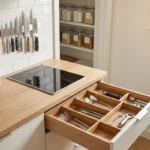
Knives go on a magnetic strip mounted to the wall above your prep area — or in a block if you rent and cannot drill. Cutting boards stand upright in a rack or lean against the backsplash behind the counter. Peeler and grater live in the closest drawer, divided into their own sections. If your counter is too narrow for a large cutting board, an over-the-sink cutting board extends your prep surface across the basin. You still access the faucet on one side while gaining 12 to 18 inches of usable workspace.
Storage Zone (cabinets, deep drawers, and every surface you are not actively cooking on):
This is where most small kitchens lose the most space — not because there is too little room, but because the room that exists is poorly used.
Start with the cabinets closest to the stove for pots and pans. Nest them inside each other. Store lids vertically in a wire lid rack or a repurposed magazine holder — this one change recovers up to 60 percent of the shelf space that stacked lids waste.
For corner cabinets, a lazy Susan solves the “reach into the black hole” problem. Place it in the lower corner cabinet and use it for your most-used pots, mixing bowls, and colander. Everything rotates to the front. Nothing gets buried.
Go vertical with what remains:
- The tops of your cabinets hold items you use monthly or less — special-occasion serving platters, bulk supplies, holiday bakeware. Use uniform baskets up there so it looks intentional, not forgotten.
- The top of your fridge works the same way. Store your largest stockpot, a slow cooker, or a bread maker in a single row. If it looks messy, one long basket hides everything.
- Inside the oven (when it is off and cool) is the best hiding spot for heavy cast-iron pans and Dutch ovens. No one sees them. No counter space is used. Pull them out when you cook, return them when you are done.
- Under-shelf wire baskets slide onto the bottom of any cabinet shelf and use the empty air between the shelf surface and the items below. This is free storage for dish towels, ziplock bags, or small packets of seasoning.
If you keep dry goods like rice, pasta, or flour, decant them into square, stackable containers. The original bags and boxes waste 30 to 40 percent of shelf space due to irregular shapes. Square containers stack cleanly and make everything visible at a glance.
Tools that have no zone are tools you do not need in the kitchen. Move them to a storage closet or remove them entirely.
Step 5: Put Everything Back — In Its Zone (Sunday Morning — 60 Minutes)
Now return only the items from your ‘Keep’ pile. Place each tool in its designated zone. Use bamboo drawer dividers to create separate sections inside drawers so tools cannot slide together.
Do not fill space just because it is there. Space in a drawer is a success, not a problem.
WikiHow’s kitchen organisation guides consistently recommend leaving 20 to 30 per cent of drawer space open to prevent re-clutter buildup within the first month.
Step 6: Add Organisers Only If Needed (Sunday Afternoon — 30 Minutes)
After everything is back in place, look at what still feels cramped. Only then decide if an organiser helps. Most small kitchens need just two things: a countertop crock near the stove and one set of drawer dividers.
The most overlooked storage surface in any kitchen is the inside of the cabinet door. A row of adhesive hooks on the back of a door holds measuring spoons, pot holders, and small lids without using any shelf space. A narrow wire rack adhesive-mounted to a door stores spice jars, cling wrap, or foil — items that are flat but always in the way on a shelf.
If your upper cabinets feel full, do not add more cabinets. Replace one or two with open floating shelves. This works especially well for the dishes and glasses you use every day. Shelves make items faster to grab, force you to keep only what fits — a natural declutter trigger — and make a small kitchen feel more open because the wall behind stays visible.
Before & After: What Actually Changes
| BEFORE | AFTER |
|---|---|
| 3 spatulas in one junk drawer | 1 spatula in a countertop crock by the stove |
| Drawer takes 5 seconds to search every time | The tool is in hand within 1 second |
| 6 mismatched cutting boards | 2 boards — one for meat, one for produce |
| Cabinets will not fully close | All cabinets close cleanly with room to spare |
| Countertop covered in rarely used items | Counter clear except for crock and cutting board |
Common DIY Mistakes to Avoid
1. Organising before decluttering. Buying drawer organisers before you remove duplicates just gives your clutter a tidier home. Always remove first, then organise.
2. Keeping ‘someday’ tools. The pasta maker, the mandoline, the bread maker — if you have not used it in six months, the ‘someday’ never comes. Donate it now.
3. Storing tools based on appearance, not function. A beautiful magnetic knife strip on the far wall looks great, but is useless if your cutting board is on the opposite side of the kitchen. Always store a tool closest to where you use it.
4. Filling empty drawer space. Space is not wasted space. It is breathing room. A drawer that is 70 per cent full is dramatically easier to use than one that is 100 per cent full.
5. Skipping the weekly reset. Without a 5-minute weekly reset — returning each tool to its assigned home — the system collapses within 2 to 3 weeks. Build it into your Sunday routine.
Pro Tips for Small Kitchen Organisation
- Use a countertop crock for your top 5 daily tools only: 1 spatula, 1 wooden spoon, 1 pair of tongs, 1 ladle, 1 whisk. Add nothing else.
- A tension rod inside an under-sink cabinet holds spray bottles upright and frees the shelf floor for cleaning supplies.
- A vertical lid organiser (a small wire rack or repurposed magazine holder) stores pot lids on their edges, recovering 60 per cent of the cabinet shelf space.
- If you have a windowsill, use it. A row of small herb pots on the sill puts fresh basil within arm’s reach while you cook. If herbs are not your thing, a single row of your most-used cookbooks works just as well.
- A stovetop cover (sometimes called a noodle board) sits across the burner grates and turns your entire stovetop into usable counter space when you are not cooking. An oversized cutting board does the same job if you do not want to buy one.
- A slim rolling cart (IKEA’s RÄSKOG is the standard — under $30, three tiers, small footprint) works as a mobile pantry, a coffee station, or a baking supply caddy. Park it beside the fridge. Roll it to the counter when you need it. Push it back when you do not.
- If the side of your fridge is exposed, it is a magnetic storage surface. Magnetic spice tins, a magnetic paper towel holder, or small magnetic baskets for wraps and bags — all of these use space that is otherwise completely empty.
- The 3-to-6 inch gap between your oven and the wall (or between your oven and fridge) fits a slim pull-out rack organiser. It hides oils, tall bottles, and cleaning supplies in a space that looks like it holds nothing.
- Label your drawer zones with small adhesive labels during the first month. It trains everyone in the household to return tools to the right spot.
- One-in, one-out rule: every time a new kitchen tool enters the home, one leaves. This prevents clutter from rebuilding.
- For renters who cannot drill: adhesive hooks (Command brand or equivalent) hold up to 7.5 lb and remove cleanly without wall damage. If you enjoy hands-on weekend projects, building a small wooden bench without screws is a practical way to add a custom storage seat or low shelf near your kitchen entry — no drilling required.
Real-Life Use Cases
Studio Apartment Kitchen (Under 50 sq ft of Counter Space)
Use a single countertop crock for 5 daily tools. Mount a magnetic knife strip on a wall or the side of the refrigerator — the fridge side itself becomes usable storage for magnetic spice tins and small baskets. Use two deep drawers with bamboo dividers. A slim rolling cart replaces a pantry for dry goods and spices. If there is no dining table, a fold-down wall-mounted table (IKEA NORBERG or similar — folds flat against the wall when not in use) gives you an eating surface that takes up zero floor space. Keep the counter completely clear except for the crock and one cutting board. If your counter is tiny, an over-the-sink cutting board extends your prep space across the basin.
Shared Household Kitchen
Assign each person or use-type their own cabinet zone. Label shelves with painter’s tape temporarily so everyone learns the system. Shared tools get shared homes — agreed on together. A shared whiteboard ‘kitchen rules’ note on the fridge helps during the transition. The most-used items stay at counter and waist height; seasonal and rarely used items — holiday platters, the turkey roaster — move to the cabinet tops or the top of the fridge where they do not crowd daily life.
Renter With No Drilling Allowed
Adhesive hooks inside cabinet doors handle measuring spoons, pot holders, and small tools. A freestanding shelf riser doubles cabinet shelf space. Tension rods hold lids and spray bottles. Open floating shelves can replace one or two upper cabinets if your landlord allows it — they make the kitchen feel larger and keep daily dishes within reach. The tops of existing cabinets and the top of the fridge are storage surfaces that require zero installation. None of these requires a single drill hole or leaves wall damage — and unlike weekend projects that involve power tools and the noise fatigue that comes with them, this entire kitchen project runs quietly from start to finish.
Final Thought
You do not need a bigger kitchen. You do not need a renovation. You need a system where every tool has one purpose and one place.
Start with your most cluttered drawer. Empty it. Return only what belongs. Do it this weekend.
FAQs: Small Kitchen Organisation for Beginners
How do I decide which kitchen tools to keep?
Keep only what you use at least once a week, and only the best version of each tool type. If two tools do the same job, keep one and donate the other.
What is the cheapest way to organise kitchen drawers?
Bamboo drawer dividers cost $8 to $14 for a set and work in any drawer. Small cardboard boxes lined with paper work as free dividers. Start with what you already have.
How long does it take to organise a small kitchen?
Plan for 3 to 5 hours spread across one weekend. The declutter phase takes the longest — the actual organising step is usually under 90 minutes.
How do I use vertical space in a small kitchen?
Mount a magnetic knife strip on the wall above your prep area. Use adhesive hooks on the inside of cabinet doors for measuring spoons and pot holders. Store pot lids vertically in a wire rack instead of stacking them flat. Place items you use rarely on top of the cabinets or fridge. Hang a wall rack or pegboard beside the stove for your most-used utensils. Every wall, door, and cabinet surface is potential storage — use it before buying a single organiser.
How do I stop my kitchen from getting cluttered again?
Follow the one-in, one-out rule and do a 5-minute Sunday reset each week. That is all the maintenance this system requires.
Can I organise a small kitchen without buying anything?
Yes. The most impactful step — decluttering and removing duplicates — costs nothing. You can build an effective zone system using what you already own before spending a single dollar on organisers.
One drawer. One tool. One place. That is where this begins.




No Comment! Be the first one.