
Picture a structural engineer choosing aluminium for a new curtain wall, or a fleet manager comparing wheel spacer specs before a purchase. Both face the same wall of numbers: tensile strength, safety factor, dry tip load, UDL. The figures matter, but their meaning often gets lost between manufacturer spec sheets and academic engineering texts.
This guide brings the full picture together in one place: what these ratings mean, how they’re determined, the standards behind them, and how to apply them safely across real-world applications, from beams and panels to columns, spacers, and truss systems.
What Are Load Ratings and Why Do They Matter?
A load rating is the maximum load a component can safely carry under a specified set of conditions, including span, support type, temperature, and load pattern. Rated capacity is the figure a manufacturer publishes after testing. Actual capacity is what an engineer determines for a specific installation. Pierce’s 75-foot aluminium aerial ladder illustrates the difference well: it carries a rated dry tip load of 750 pounds, built on a structural safety factor of 2.5 to 1, meaning it can theoretically withstand two and a half times its rated load before structural failure.
Every load-bearing component deals with several load types. Dead load is the permanent weight of the structure itself, usually already built into published tables. Live load is the temporary weight applied during use. Dynamic load covers shock, vibration, and wind gusts, and standard tables generally exclude it, requiring separate engineering review. Environmental loads such as wind, ice, and snow round out the list; the Pierce ladder, for instance, assumes winds up to 35 miles per hour and ice buildup up to a quarter inch.
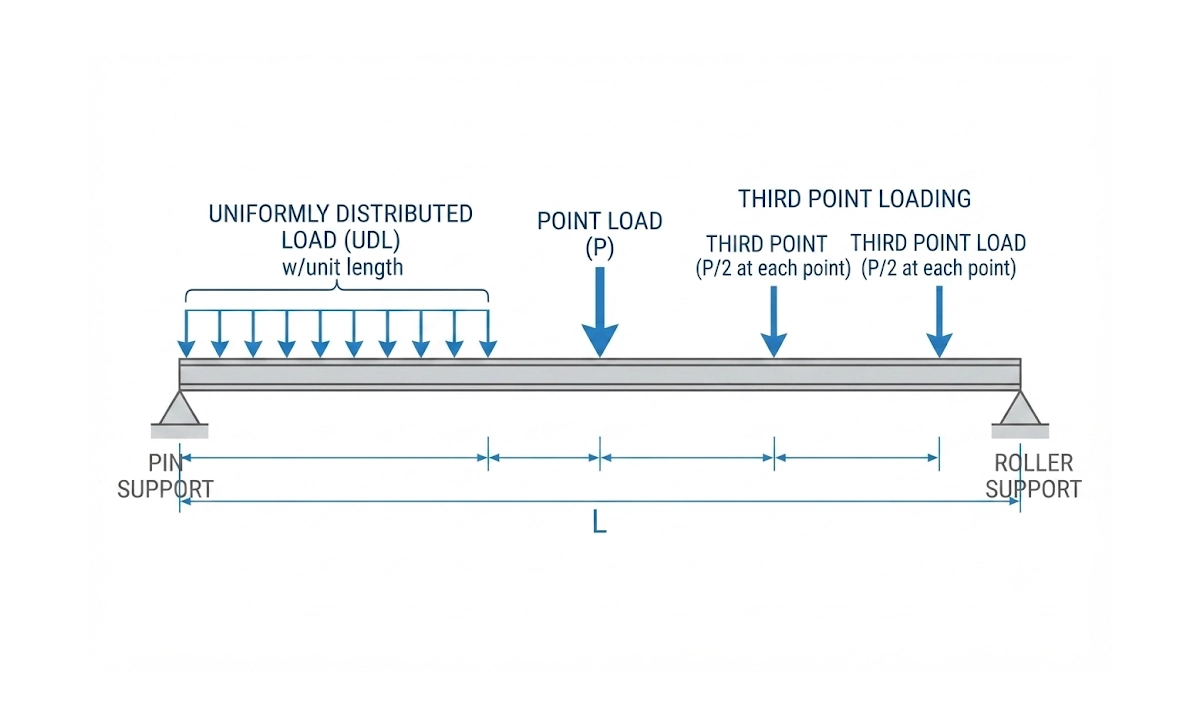
How a load is applied matters as much as how much is applied. A uniformly distributed load (UDL) spreads weight evenly across a span, while a point load concentrates weight at a single spot, whether at the centre, third, quarter, or fifth point. The same total weight produces very different structural responses depending on which pattern it follows, which is why tables list capacities separately for each.
A safety factor is the ratio between a material’s ultimate strength and its maximum working load, and it exists because real-world conditions rarely match lab conditions exactly. Aluminium structures typically use safety factors between 1.5 to 1 and 3 to 1 depending on application and standard.
How Aluminium Load Ratings Are Determined
Load ratings are built on formal design standards. In the United States, the Aluminium Design Manual (ADM-2020) covers allowable strength and load/resistance factor design. Europe uses Eurocode 9 (BS EN 1999-1-1), Australia and New Zealand use AS/NZS 1664, and Canada uses CSA 157-17. Each standard sets its own allowable stresses and deflection limits, so a rating under one standard doesn’t automatically apply under another.
| Standard | Region | Focus Area |
| ADM-2020 | United States | Allowable strength and load/resistance factor design |
| Eurocode 9 | Europe | Design of aluminium structures |
| AS/NZS 1664 | Australia / New Zealand | Aluminium structures design |
| CSA 157-17 | Canada | Strength design in aluminium |
A published rating usually reflects several structural checks: shear, bending, tension, and compression, plus combined checks where bending, shear, and compression act together. Skipping combined checks is a common cause of real-world structural failure. Reputable manufacturers back their tables with third-party engineering verification, and modern design software, including tools built on finite element analysis, lets engineers check complex geometries against multiple standards at once.
Key Factors That Affect Aluminium Load Capacity
Alloy and temper. 6061-T6 is the workhorse of structural aluminium, with tensile strength around 45,000 PSI and yield strength around 40,000 PSI, used in beams, spacers, columns, and bus pipe. 6063-T6 trades some strength for better extrudability, common in architectural extrusions and higher current-carrying electrical work. 5052, 5005, and 3003 alloys show up frequently in honeycomb panels and sheet products, each balancing corrosion resistance and cost differently. 7075 delivers much higher strength (around 83,000 PSI) but with reduced corrosion resistance, making it popular in aerospace. Temper designation (T6, T5, H32, O) changes mechanical properties as much as the alloy itself.
Geometry. I-beams, C-channels, and hollow sections distribute forces differently, so checks must run against the specific cross-section. In honeycomb panels, face sheet thickness, core height, and core density all shape capacity, meaning two panels of identical outer size can perform very differently. Thin-walled profiles are especially vulnerable to concentrated point loads.
Coatings and manufacturing. Powder coating, PVDF finishes, and anodising don’t add load capacity directly, but they guard against corrosion-driven degradation over time. Extrusion sets the grain structure behind a part’s strength, while brazing (a metal-to-metal bond without adhesives) improves peel strength and high-temperature performance in honeycomb panels compared to adhesive-bonded designs.
Environment. T6 Billet aluminium holds its rated performance from -30°F to 180°F. Outdoor components need wind, ice, and corrosion assessments specific to their environment, and sustained vibration calls for a fatigue analysis beyond static numbers.
Temperature swings that affect a load rating on a job site are the same swings homeowners manage inside their own walls. Just as engineers account for heat transfer in aluminium framing, homeowners looking to control energy costs often start by learning how to insulate windows to keep heat out, since window frames face many of the same thermal stresses as larger aluminium structures.
Fire performance. Traditional composite panels depend on flame-retardant adhesive films, while brazed honeycomb panels resist fire better since the metal bond doesn’t decompose under heat. ACM panels use either a PE core (lower fire rating) or an FR core (stricter code compliance), with fire ratings classified as A2 or B1.
Aluminium Load Ratings Across Applications
Structural beams depend on section properties and must clear shear, bending, tension, compression, and combined-load checks under the applicable standard.
Honeycomb panels, most commonly 4×8 feet, are used in curtain walls and cleanrooms; capacity depends on face sheet thickness, core density, and coating rather than panel size alone.
Aluminium columns, such as Westbury’s square smooth columns (6″, 8″, and 10″ sizes, up to 20 feet), serve as load-bearing residential and commercial supports, lighter than wood or steel and resistant to warping, rust, and rot.
Aluminium columns often anchor covered porches and patios, the same spaces homeowners then furnish for outdoor relaxation. A well-chosen piece of outdoor seating, such as a leather chaise lounge, pairs naturally with a column-supported patio roof, since both need to hold up under the same sun and moisture exposure.
Aerial ladders: Pierce’s 75-foot aluminium ladder carries a 750-pound dry tip load and 500-pound wet rating, flowing up to 1,500 gallons per minute, backed by a 20-year structural warranty.
Wheel spacers made from 6061-T6 billet aluminium carry up to 4,500 pounds per spacer; vehicles over 5,000 pounds may need steel alternatives instead.
Cable trays and bus pipe depend on width, rung spacing, and material gauge; aluminium bus pipe conducts equivalent electrical loads at roughly half the weight of copper.
Truss systems used in entertainment rigging list capacity by UDL, centre point, and fractional point loads, with dynamic loads like wind and shock requiring separate assessment.
How to Read and Interpret Load Tables
Most load tables break into UDL, centre point, third point, quarter point, and fifth point sections, with span length increasing down the left column and capacity shrinking as span grows. Always confirm whether a table already accounts for the component’s own weight. Key terms include payload capacity (total load carried), operating range (the angular window a rating applies within), and calculated deflection (which can run higher in the field due to manufacturing tolerances). Point loads belong at designated panel points, not between them, and any scenario outside a table’s published maximums calls for a professional engineer rather than a guess.
Aluminium vs. Other Materials
Steel offers higher raw strength but roughly three times aluminium’s density, so aluminium’s strength-to-weight ratio often wins where weight matters, from aerospace to automotive parts. Steel also needs protective treatment against corrosion, while aluminium forms a naturally protective oxide layer.
Aluminium’s natural resistance to corrosion also makes it a common choice for structures near water, from dock framing to equipment enclosures beside a pool. Homeowners planning a backyard water feature often compare options like swim spas vs hot tubs before settling on a design, and whichever they choose, the surrounding framing benefits from the same corrosion resistance that gives aluminium an edge over untreated steel.
For electrical work, aluminium carries an equivalent load at about half the weight of copper. Aluminium composite material (ACM) panels deliver stiffness comparable to solid aluminium plate at less weight and cost, typically 3.5 to 5.5 pounds per square foot.
Common Mistakes and Safety Considerations
Confusing dry and wet load ratings is one of the most frequent errors, along with forgetting that most tables exclude dynamic loads like wind, seismic activity, and ice. Skipping a check on environmental de-rating, whether temperature, wind, or corrosion exposure, can leave a component underperforming its published rating. Structural failures often trace back to combined loading rather than a single load type, so combined checks matter as much as individual ones. Point loads need to land at designated panel points; applying weight elsewhere can trigger localised failure the design never anticipated.
Conclusion
Aluminium load ratings come from several factors working together: alloy, temper, geometry, manufacturing process, and environment, not a single number on a spec sheet. Always match the applicable design standard, whether ADM-2020, Eurocode 9, AS 1664, or CSA 157, against manufacturer-published tables, and remember that environmental conditions can meaningfully reduce real capacity below the nominal rating. When a load scenario falls outside published data, the right call is a qualified structural engineer. Across construction, automotive, and electrical applications, aluminium’s strength-to-weight ratio and corrosion resistance keep it one of the most practical load-bearing materials available, provided its ratings are read with the right context in mind.
FAQs
What is the load capacity of 6061-T6 aluminium?
Roughly 45,000 PSI tensile strength and 40,000 PSI yield strength, though actual component capacity also depends on geometry, span, and load pattern.
Is aluminium strong enough for structural applications?
Yes. It’s used in load-bearing columns, aerial ladders rated for 750-pound tip loads, entertainment truss systems, and automotive spacers rated to 4,500 pounds each.
Do load tables include the component’s own weight?
It depends on the manufacturer. Some build self-weight into their engineering calculations; always confirm with the specific manufacturer.
What safety factor is used for aluminium structures?
Typically 1.5 to 1 up to 3 to 1, depending on application and standard. Pierce aerial ladders use 2.5 to 1.
Can aluminium handle dynamic or shock loads?
Standard tables generally exclude dynamic loads such as shock, wind, and seismic activity, which need separate engineering assessment.
What is the strongest aluminium alloy for structural use?
7075-T6 offers the highest strength (around 83,000 PSI) but at higher cost and lower corrosion resistance. 6061-T6 remains the most widely used structural alloy for its balance of strength, cost, and corrosion resistance.
How does aluminium compare to steel for load-bearing use?
Aluminium runs about a third of steel’s density and roughly a third of its elastic modulus, but its strength-to-weight ratio frequently matches or beats steel’s. Steel tends to win where raw stiffness or very high absolute loads are the priority, while aluminium excels where weight reduction and corrosion resistance matter more.

Other Articles

Spot Emotional Spending Triggers Before You Click ‘Buy’




No Comment! Be the first one.