Picture a foreign head of state stepping off a plane in London or Berlin. The tarmac is lined with security, the flags are out, and behind them sits a jet with a navy belly, red and gold stripes, and a shine that makes every other aircraft on the runway look plain. That plane isn’t a royal jet from the Gulf. It’s the new Air Force One, and it used to belong to Qatar’s ruling family.
On July 1, 2026, President Trump boarded this Boeing 747-8 for the first time as a working head of state, flying to North Dakota for an America 250 event. The jet, gifted by the government of Qatar, had just finished more than a year of retrofitting. It’s the most talked-about plane in American politics right now, and it comes loaded with questions. Where did it come from? Why did Qatar give it away? And is it actually safe enough to carry a president?
Here’s the full story.
What Is the Qatari Air Force One — and Why Does It Exist?
The plane most people call the “Qatari Air Force One” is officially known as the VC-25B Bridge. It’s a Boeing 747-8, originally built as a private jet for Qatar’s royal family, that the U.S. Air Force converted into a temporary presidential aircraft. It flies alongside the two ageing VC-25A jets that have served presidents since 1990.
The Air Force needed a stopgap. Boeing has been building two brand-new Air Force One jets for years, but that program has been delayed repeatedly and isn’t expected to finish until 2028. Meanwhile, the current fleet is more than three decades old. Trump wanted a newer plane sooner, and Qatar happened to have one sitting mostly unused.
The “Bridge” Aircraft Explained
The word “bridge” is doing a lot of work here. This jet isn’t meant to be a permanent Air Force One. It’s meant to carry the president in the gap between the retiring 1990s planes and the future Boeing-built fleet. Once those new jets are ready, likely around 2028, the Qatari plane is expected to be handed over to Trump’s presidential library rather than staying in government service.
A Brief History: From Qatar’s Royal Fleet to U.S. Air Force
This particular aircraft has changed hands and names more than once. Boeing delivered it in April 2012 to Qatar Amiri Flight, the VIP transport service for Qatar’s royal family, registered as A7-HJA. It was soon re-registered A7-HBJ, a nod to Hamad bin Jassim bin Jaber Al Thani, Qatar’s former prime minister and the plane’s main user for over a decade.
In June 2023, the jet was sold and delivered to Global Jet Isle of Man, picking up the registration P4-HBJ. Reports at the time suggested it had become privately owned and was sitting mostly idle. That changed in 2025, when the Trump administration began talks with Qatar about acquiring the aircraft. By August 2025, once it was in American hands for modification work, it carried a new U.S. registration, N7478D, before eventually becoming the VC-25B Bridge.
Trump first toured the jet in February 2025 at Palm Beach International Airport, before it flew back to Doha. Months of negotiation followed, and Qatar’s government formally agreed to hand it over that spring. The Pentagon accepted the aircraft in May 2025, and contractor L3Harris began the conversion work not long after.
Inside the $400 Million “Flying Palace”
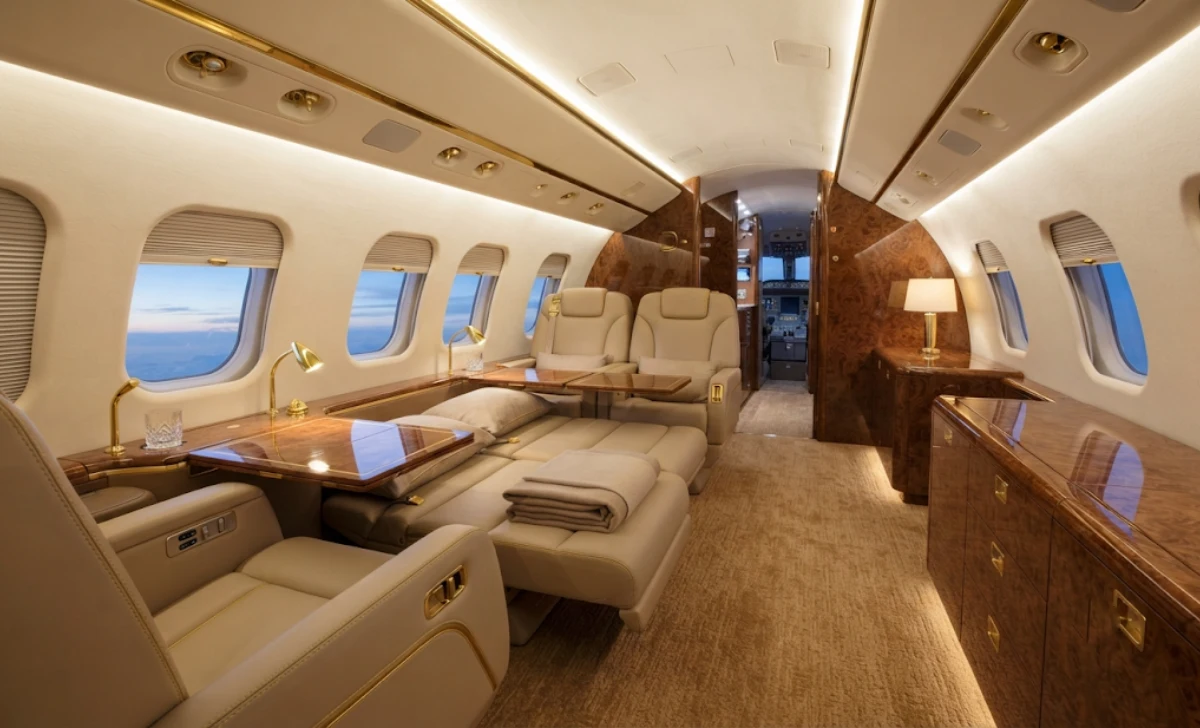
Even before the U.S. touched it, this was one of the most extravagant aircraft ever built. Its interior was designed by Cabinet Alberto Pinto, a well-known French design firm, and it was outfitted with rugs from Tai Ping Carpets, sycamore and wacapou wood panelling, and artwork from sculptor Alexander Calder.
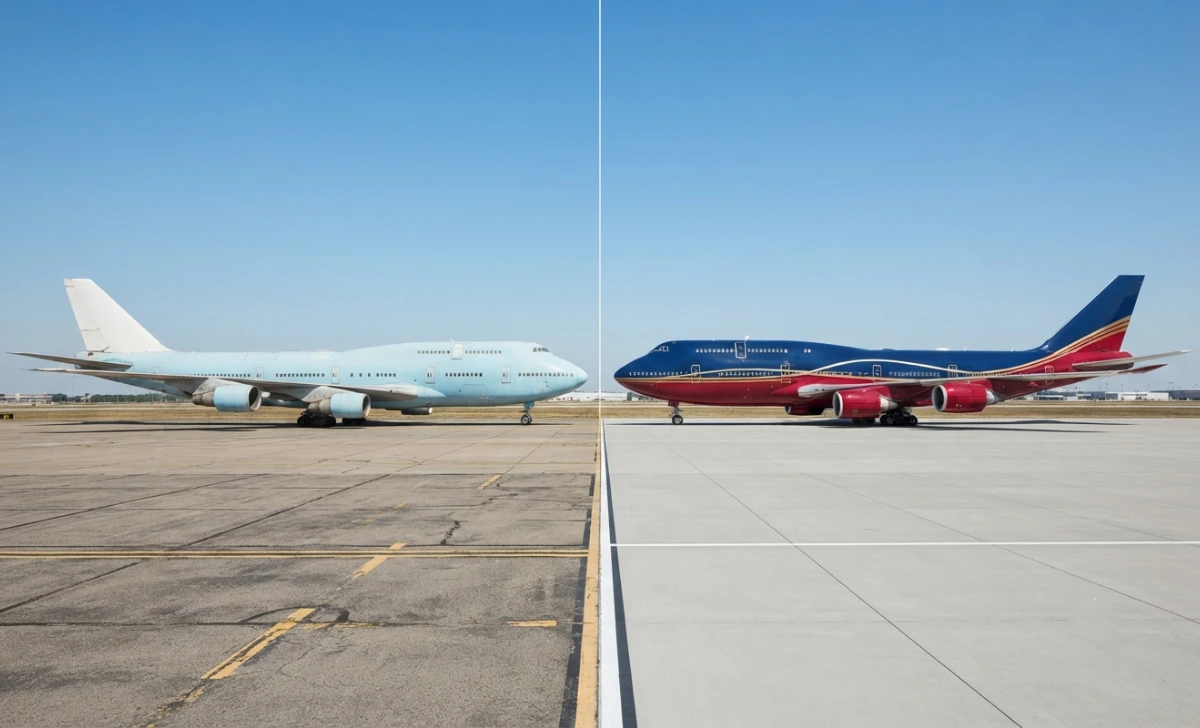
Since the retrofit, the plane has taken on Trump’s personal style. Gone is the pale blue paint scheme that Air Force One has worn since the Reagan years. In its place is a bold navy, red, and gold design that matches Trump’s private jet.
Luxury Amenities That Defy Imagination
Photos shared from the jet’s first flights show off features rarely seen on a government aircraft, including:
- Leather seats that recline completely flat
- Seatbelts stamped with the presidential seal
- Tan carpets and gold-toned light fixtures
- Formal dining service on gold and white china bearing the presidential seal
- Wood panelling and finishes carried over from its royal ownership
Trump has called it “the world’s most luxurious plane” and said it delivers a level of comfort nobody has seen before on a presidential aircraft.
The Technology Behind the Glamour
The gold fixtures and flat-bed seats get the headlines, but the real question is what’s happening behind the walls. Air Force One is normally built to survive a nuclear crisis, carry secure communications equipment, and let the president command the military from the sky. Converting a commercial jet to do all that usually takes years and billions of dollars, and aviation experts have raised doubts about how much of that capability actually made it into this plane in the time available.
Work at this level rarely goes right on the first pass. Engineers on projects like this improve mainly by repeating the same checks and installs under tighter conditions each time, catching what failed last cycle before moving to the next. That kind of structured, repeated skill-building is the same idea behind disciplined repetition as a learning method, just applied to aircraft systems instead of a classroom.
The Qatari Air Force One vs. The Old Air Force One: A Side-by-Side Comparison
| Feature | Qatari 747-8 (VC-25B Bridge) | Old VC-25A |
|---|---|---|
| Entered presidential service | 2026 | 1990 |
| Base aircraft | Boeing 747-8I | Boeing 747-200B |
| Origin | Gifted by Qatar, valued around $400M | Purchased and built for the U.S. government |
| Interior style | Ultra-luxury, gold fixtures, designer finishes | Functional, government-standard |
| Security capability | Partial, fast-tracked upgrades | Full military-grade systems |
| Communications | Standard encrypted systems | Nuclear-survivable battlefield command |
| Expected lifespan in service | Interim, until 2028 or later | Retiring after roughly 35 years |
Why Did Qatar Gift a $400M Plane to the United States?
Qatar’s motives sit at the centre of a lot of speculation. The most straightforward explanation is diplomatic. Qatar has spent years positioning itself as a close U.S. partner in the Middle East, hosting a major American military base and playing mediator in several regional conflicts. Handing over a jet that had become difficult to sell, since it required a very specific buyer, gave Qatar a high-profile way to strengthen ties with the Trump administration.
Energy is a big part of why that relationship matters so much to Washington in the first place. Qatar remains one of the world’s largest LNG exporters, and its Ras Laffan complex has come up repeatedly in Shell’s own 2026 LNG outlook as a facility central to global gas supply. A gesture as the jet gift fits into a much bigger picture of Qatar working to stay close to the country that buys, ships, and depends on the energy it exports.
There’s also a financial angle. The aircraft had reportedly sat on the market for years without finding a buyer, so gifting it let Qatar turn an idle asset into political goodwill rather than a continuing expense.
The Controversy: Security, Ethics, and a $1 Billion Question
Not everyone is cheering. The gift has drawn criticism from lawmakers in both parties, along with ethics experts and aviation analysts.
Legal scholars have pointed to the Constitution’s Emoluments Clause, which limits federal officials from accepting gifts from foreign governments without approval from Congress. Richard Painter, a former White House ethics lawyer, called the arrangement inappropriate and warned it sets a troubling precedent for future presidents.
Security concerns run just as deep. Richard Aboulafia, an aviation analyst at AeroDynamic Advisory, has repeatedly warned that a plane owned by a foreign government for over a decade can’t be fully trusted without tearing it apart piece by piece to check for hidden listening devices. He’s also argued that the retrofit skipped major capabilities that the outgoing Air Force One fleet has, including certain encrypted communications and battlefield command systems.
The $1 Billion Conversion Cost Debate
The retrofit’s price tag has become its own controversy. Officials have said the security upgrades alone cost less than $400 million, but reporting from the New York Times found that roughly $934 million was quietly shifted from a nuclear missile modernisation program to help pay for the jet’s conversion. That funding move, combined with the fact that the total cost was never made public, has fueled bipartisan frustration on Capitol Hill.
A project this size, spread across multiple contractors, a secretive budget line, and a hard deadline, is really a scaling problem as much as an engineering one. Large organisations juggling several moving parts at once tend to succeed or stumble based on the same fundamentals covered in this breakdown of operational infrastructure for business scaling, where the difference between smooth execution and constant firefighting usually comes down to how well the underlying process is documented before the pressure hits.
Key concerns raised by critics include:
- Whether the plane meets the same security standards as the retiring Air Force One fleet
- Where the retrofit money actually came from, and why it was hidden inside another program
- Whether accepting a gift this large from a foreign government violates federal gift rules
- What kind of precedent this sets for future administrations accepting gifts abroad
What Happens to the Qatari Jet After Trump Leaves Office?
The current plan, according to White House officials, is for the aircraft to eventually go to Trump’s presidential library foundation once his term ends in January 2029. That detail alone has drawn scrutiny. Columbia law professor Richard Briffault has pointed out that if the plane ends up benefiting Trump’s personal library rather than staying in government service, it raises questions about whether it was ever really a gift to the country at all.
Until then, the jet will keep flying as a working Air Force One, alongside the two remaining older 747s, one of which is currently being taken out of rotation for maintenance and eventual retirement to a museum.



No Comment! Be the first one.