Operational infrastructure for business scaling is the set of processes, organizational structures, data systems, and decision rules a company puts in place so that growth doesn’t outrun its ability to deliver consistent, quality work. Most founders learn this the hard way. At ten or twenty people, a company runs on instinct, shared context, and a handful of people who simply know how things get done. At fifty, that same approach starts to crack.
This is what operators call organisational debt: the gap between how complex a business has become and how formally its processes have been documented, automated, or distributed across a team. Like financial debt, it accrues quietly during the sprint for product-market fit, and the interest comes due during the growth phase, in the form of missed deadlines, inconsistent customer experience, and a leadership team stuck firefighting instead of building.
The fix isn’t more hours from the founding team. It’s a deliberate operating system, built around four connected pillars: process and technology architecture, people and organisational structure, data and operating rhythm, and a stage-appropriate roadmap for rolling it all out. The rest of this guide walks through each pillar and gives you a practical, sequenced plan to put it into practice.
It helps to be precise about what this guide is not. It’s not a pitch for a particular software category, and it’s not a call to add layers of approval for their own sake. Bureaucracy and infrastructure are often confused, but they aren’t the same thing. Bureaucracy adds steps that protect no one and slow everyone down. Infrastructure removes ambiguity so that the right person can make the right call quickly, without waiting on someone who happens to remember how it worked last time. A well-built operating system should make a company feel faster as it grows, not slower.
The companies that get this right tend to treat operations as a discipline with its own owner, the same way they treat product or sales, rather than something the founder handles in the gaps between other work. That single shift, from operations as an afterthought to operations as a deliberate function, is usually the dividing line between businesses that scale smoothly and businesses that stall out at the same headcount for years.
The 4-Pillar Operational Scaling Model
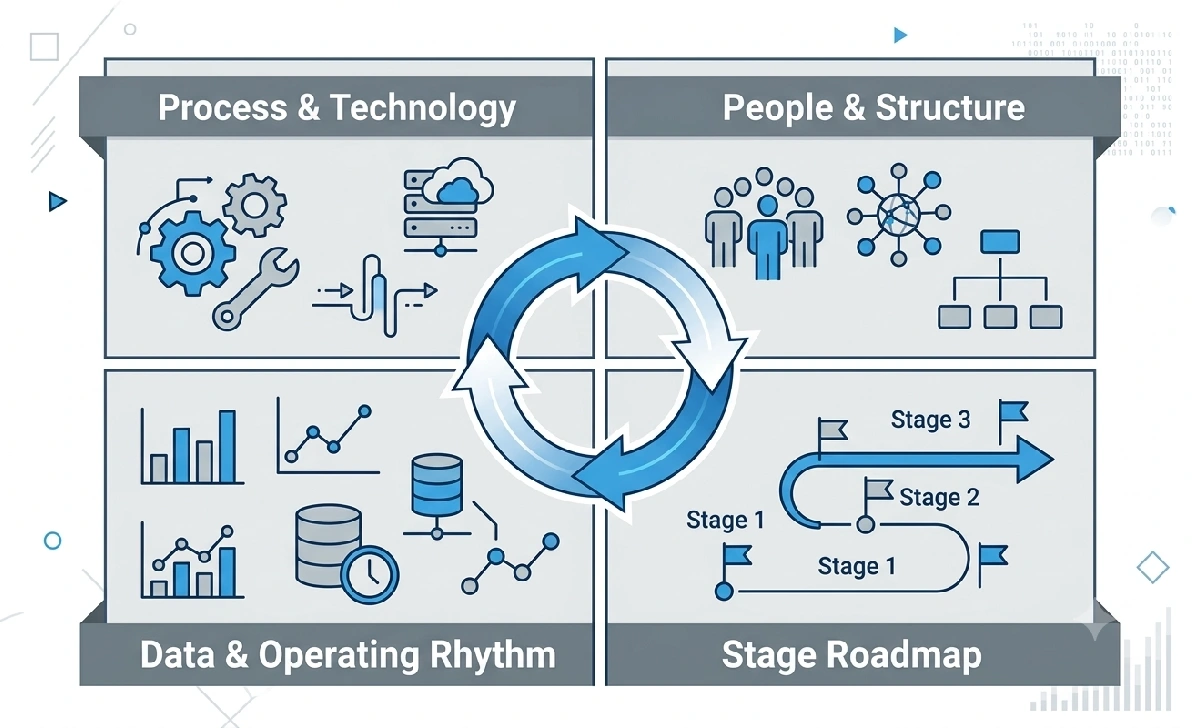
Before going section by section, it helps to see the whole picture. The four pillars are interdependent, not optional add-ons:
- Process and Technology Architecture: how work gets documented, standardised, and eventually automated
- People, Structure and Governance: how the org chart and decision rights change as headcount grows
- Data and Operating Rhythm: how the business measures itself and runs its meeting cadence
- Stage-Specific Roadmap: what to prioritise at each revenue stage, since a 50-person company and a 500-person company need different things
Skipping any one of these pillars tends to undermine the other three. Strong processes without clear decision rights stall in committee. Good reporting without a documented process just measures the chaos more precisely.
Pillar 1: Designing a Process and Technology Architecture That Flexes
Process-First Design: Documenting Your Value Streams
The instinct when things feel chaotic is to buy software. Resist it until the underlying process has been mapped. Value stream mapping, borrowed from manufacturing and adapted to service businesses, traces a piece of work from start to finish, for example, lead to cash or hire to retire, and marks every handoff, approval, and wait time along the way.
Most companies find that a small number of these value streams cause most of the friction customers and employees actually feel. Map the one causing the most pain first, simplify it on paper, and only then decide what, if anything, should be automated.
A useful discipline here is to write the process down as it actually runs today, not as it’s supposed to run. The gap between the two is usually where the real problems live. A support ticket that’s supposed to take four hours often takes two days because it bounces between three people before landing with the person who can actually fix it. Mapping reveals these handoffs in a way that no all-hands meeting or status update ever will, because the people doing the work day to day are rarely the ones in the room when strategy gets discussed.
Once the current state is mapped, look for three specific things: steps that exist only because of a one-off exception years ago, approvals that route to someone too senior to give them real attention, and any point where work waits more than a day for no clear reason. Removing those three categories alone often shortens a process by half before a single tool gets introduced.
The Composable Tech Stack: Purpose, Not Product
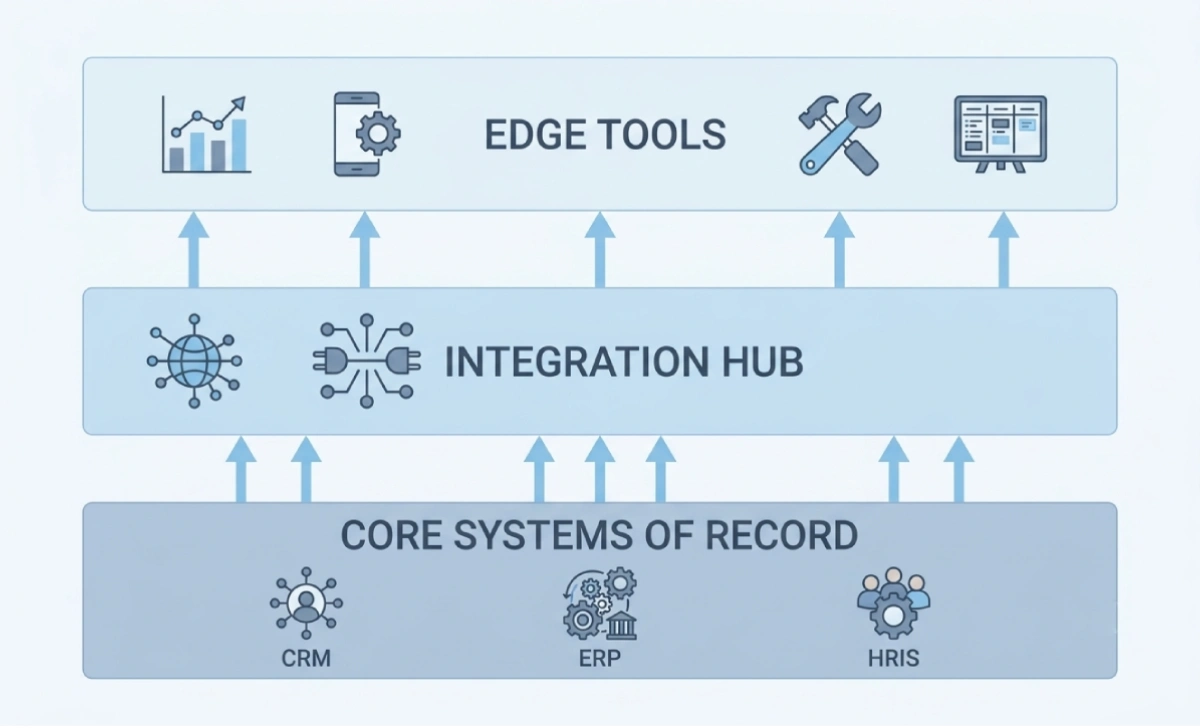
Once a process is documented, the technology question becomes much clearer. A useful way to think about the stack is in three layers: a core layer of systems of record such as a CRM, ERP, and HRIS; a hub layer of integration tooling that moves data between systems without hard-coding every connection; and an edge layer of specialist tools for individual teams. Building in layers, rather than buying one giant suite, keeps the company from being tied to a single vendor’s roadmap as needs change.
From Documentation to Automation: A Maturity Model
Most processes move through four stages: ad hoc, where the outcome depends on who happens to handle it; documented, where a written standard operating procedure exists; standardised, where the workflow is enforced through a tool or checklist; and automated, where a system runs the routine steps with a person reviewing exceptions.
Take employee expense reimbursement as an example: it starts as an email to a manager, then becomes a written policy, then a structured approval form, and finally an automated workflow that only flags unusual claims for a person to review. That last stage is increasingly handled by AI agents rather than older rule-based automation, and the pace of change behind it, including developments in artificial general intelligence, is worth tracking as you plan your own roadmap.
Pillar 2: Architecting Your People, Structure and Governance
Organisational Design: From Generalists to Specialists
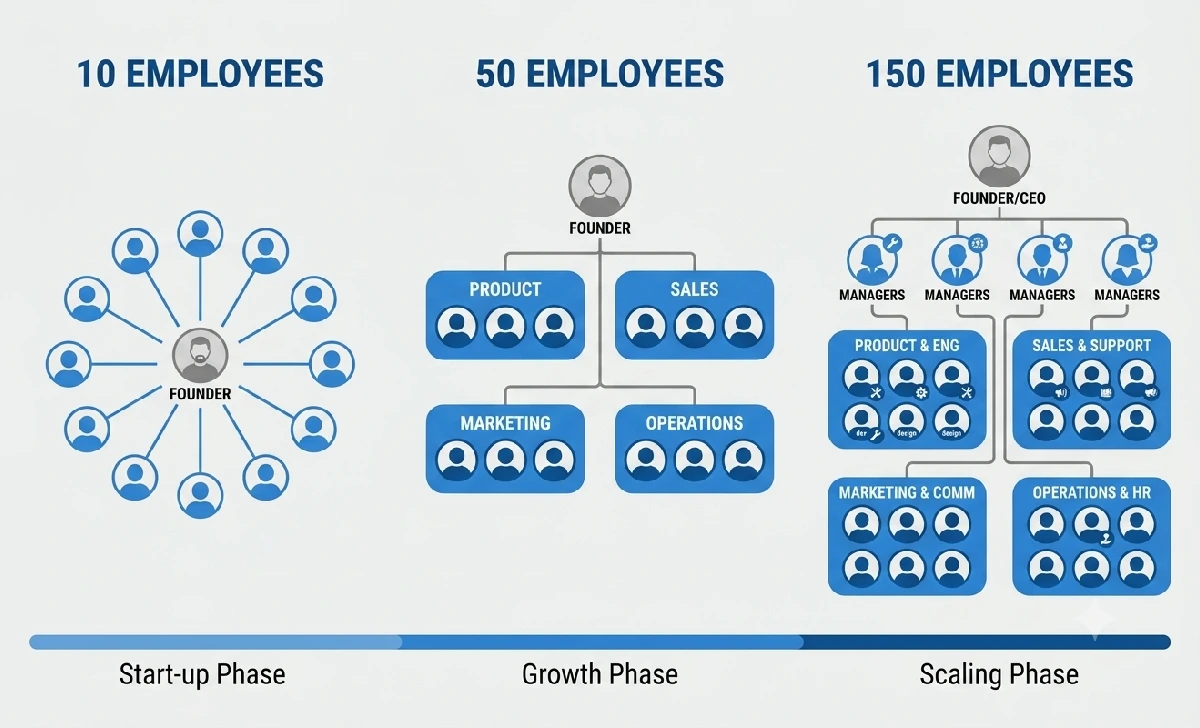
Org structure has to evolve with headcount. A ten-person team is mostly generalists working directly with the founder. By fifty, functions start to separate; by a hundred and fifty, most companies need a layer of managers and the beginnings of specialised teams. A common rule of thumb caps span of control at five to seven direct reports per manager; beyond that, decisions slow down and quality of coaching drops.
This transition is often where culture and structure pull against each other. Early employees who thrived as generalists sometimes resist the idea of narrower, more defined roles, reading it as a loss of trust rather than a natural consequence of size. The healthiest way through this is to be explicit about why the change is happening: a structure that made ten people fast will make a hundred people slow, simply because too many decisions still funnel through too few people who all have full calendars.
A practical marker to watch is how often the same two or three names show up as the bottleneck on unrelated projects. If one person is consistently the blocker across hiring, vendor approvals, and product decisions, that’s a structural problem to fix, not a workload problem to push through with longer hours.
The Decision Operating System: How to Reduce Founder Bottlenecks
As a company grows, the founder or CEO can no longer be the final approver on every decision without becoming the bottleneck for the whole business. A RACI model, short for Responsible, Consulted, Accountable, and Informed, makes it clear who decides what. A simple approval authority table works well in practice:
| Role | Spend Approval Limit | Decision Type |
| Manager | Up to $5,000 | Routine, recurring spend |
| VP / Department Head | Up to $50,000 | New vendor or campaign |
| CEO / Executive Team | Above $50,000 | Strategic or contractual commitments |
Knowledge Management: A Shared Reference Point for the Company
As headcount grows, institutional knowledge can’t live only in people’s heads. A well-organised internal wiki or handbook, where each policy or process is written once and linked to rather than re-explained in every channel, prevents the same questions from being answered a dozen different ways by a dozen different people.
Pillar 3: Data Infrastructure and the Operating Rhythm
Defining Your North Star and Supporting Metrics
Pick one output metric that reflects whether the business is genuinely succeeding, and a small set of input metrics that predict it. For a B2B software company, the output metric might be active accounts, with inputs like demos booked and trial activation rate feeding into it. Too many top-level metrics dilute focus; too few miss early warning signs.
The test for a good metric tree is whether a department head, looking only at their own input metrics, can predict what’s about to happen to the company-wide number before it shows up in a monthly report. If marketing’s lead volume drops, sales should be able to see that coming weeks before the close rate falls, rather than discovering it after the quarter is already lost. Building that kind of early visibility is one of the most concrete returns on investing in this pillar.
Building a Single Source of Truth
Manual spreadsheets are the enemy of consistent reporting because every copy drifts from the original. As the business grows, data should flow automatically from the CRM, ERP, and other systems of record into one reporting layer that the whole company trusts, rather than being re-entered or recalculated by hand in different departments.
A simple test for whether a company has reached this point: ask two department heads for the same number, such as last month’s revenue or active customer count, without telling them you’re comparing answers. If the figures don’t match, the company doesn’t yet have a single source of truth, no matter how sophisticated any individual dashboard looks. Closing that gap is usually a higher-leverage project than adding another tool to the stack.
The Meeting Cadence That Drives Execution
An effective operating rhythm has layers: an annual or quarterly strategy session that sets direction, a monthly business review that checks progress against goals, a weekly tactical meeting that clears short-term blockers, and a daily check-in for teams running fast-moving work. Each layer should answer a different question; meetings stall when a weekly tactical session also tries to cover quarterly strategy. Some of this planning connects directly to financial resilience, and founders setting up their first reserve fund may find it useful to read how entrepreneurs build a rainy day fund before locking in their own operating budget.
A Stage-Specific Implementation Roadmap
Stage 1: Seed to $3M ARR (Survival Mode)
Focus on a lightweight operational manual in a shared document, a basic CRM for pipeline visibility, and a dashboard with three to five core metrics. The goal at this stage is simple process awareness, not formal systems.
Stage 2: $3M to $20M ARR (Foundation Building)
This is typically when a company makes its first full-time operations hire. Core processes like hire-to-retire and lead-to-cash get formally documented, a proper ERP or HRIS replaces spreadsheets, and a lightweight RACI model clarifies who approves what. The goal is predictable, repeatable core operations.
Stage 3: $20M+ ARR (A Scaled Operating Model)
At this stage, dedicated operations functions, a proper integration layer connecting systems, a formal data warehouse, and an established multi-layered meeting rhythm are all in place. The goal shifts to efficient growth supported by controlled, measured experiments rather than guesswork.
It’s also worth building in contingency planning for events outside your control. Supply shocks, regional disruptions, or unusual public health incidents, such as the hantavirus outbreak linked to a cruise ship, are reminders that a mature operating model needs a business continuity plan, not just a growth plan.
The Operational Health Check: A Diagnostic Scorecard
Score your company from 1 (chaotic) to 5 (mature) on each of the following components to find your biggest constraint:
| Component | Score (1-5) |
| Process documentation | ___ |
| Technology integration | ___ |
| Metric clarity and reporting | ___ |
| Decision rights and approvals | ___ |
| Organizational structure | ___ |
| Meeting cadence | ___ |
| Knowledge management | ___ |
| Hiring and onboarding process | ___ |
| Financial controls | ___ |
| Risk and continuity planning | ___ |
Conclusion
Operational infrastructure isn’t overhead. It’s the structural advantage that lets a company grow without growth itself becoming the source of every new problem. None of the four pillars needs to be built perfectly on the first attempt; the goal is steady progress from chaotic and reactive to documented and measured, not instant mastery.
Use the scorecard above to find your single highest-leverage starting point, and commit to fixing one constraint this quarter rather than trying to overhaul everything at once.
FAQs
What’s the first step in building operational infrastructure for business scaling?
Start with an honest audit. Map your single most critical value stream, such as lead-to-cash, to find the one bottleneck causing the most customer or revenue friction. Fix that process end-to-end before buying any new software.
When should a startup stop relying on instinct and invest in operations?
Typically around 15 to 25 employees. Before that point, the CEO effectively acts as the operations leader. The signal to change is when information starts living only in people’s heads, the CEO becomes the approval bottleneck for every decision, and customer experience becomes inconsistent.
What matters more for scaling, process or culture?
A culture built around process matters most. You can’t have consistent execution without documented processes, but rigid adherence without room for improvement will stifle good ideas. The goal is a culture that fixes the system when something breaks, rather than blaming the person who happened to hit the gap.



No Comment! Be the first one.