
Has artificial general intelligence already been achieved? This question is no longer science fiction—it’s a live debate among experts at UC San Diego who recently published their answer in Nature. Four scholars argue that current AI systems already meet reasonable standards for AGI. Industry leaders like Sam Altman disagree, saying AI is still “missing something quite important.” The truth sits somewhere between these positions, shaped by how we define AGI itself.
This guide explains what AGI actually is, why experts disagree about whether we’ve reached it, and what it means for your job and industry. We’ll cover the latest 2026 research, competing timelines, and practical implications you need to understand now.
What Is Artificial General Intelligence?
Artificial General Intelligence refers to an AI system that can reason, learn, and solve problems across multiple domains at levels comparable to humans. The word “general” is key. Today’s AI excels at narrow tasks—playing chess, translating languages, generating images. A general AI would handle whatever humans can handle, from writing code to diagnosing diseases to negotiating contracts.
Current AI lacks this breadth. GPT-4 can write a poem, debug code, and explain quantum physics, but it can’t hold a job by itself or continuously improve through real-world experience. It can’t plan a five-year project or recover from mistakes like humans do.
What AGI does NOT require: perfection, knowing everything, human-level embodiment, or superintelligence. Just like a human doctor isn’t perfect but is still intelligent, an AGI doesn’t need flawless judgment. It needs flexibility across domains and the ability to adapt to new situations. OpenAI defines it simply: “A highly autonomous system that can do a human’s job.”
Has AGI Already Been Achieved? The 2026 Expert Debate
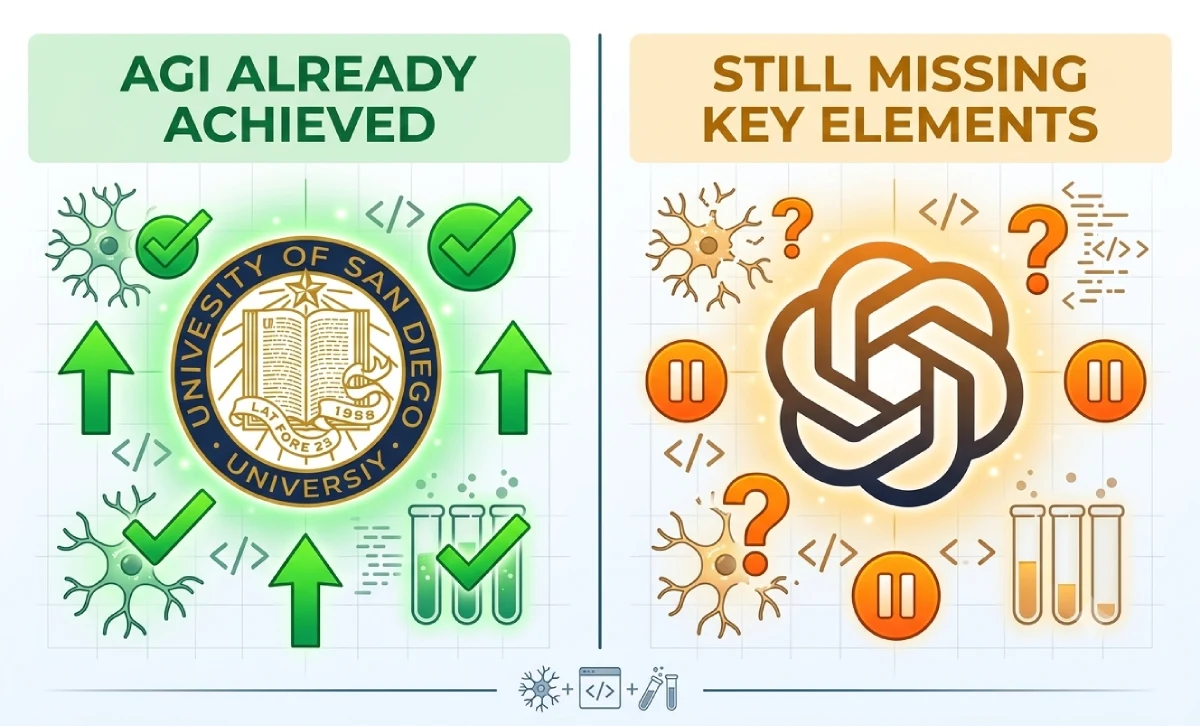
The UC San Diego team made a surprising claim: we already have AGI. Their argument is straightforward. Current large language models meet expert-level thresholds. GPT-4.5 performed at gold-medal olympiad levels in multiple domains and passed 80th percentile benchmarks for human-level performance. In Turing tests—where judges decide if they’re talking to a human—GPT-4.5 was judged human 73% of the time, more often than actual humans in the same test.
The scholars point out a flaw in human reasoning: we excuse human error like false memories and hallucinations as natural limitations of human intelligence. Yet we disqualify the same errors in machines. Physical embodiment also isn’t required. Stephen Hawking was intelligent without being able to move independently. Why should intelligence require a body?
Sam Altman, OpenAI’s CEO, takes the opposite view. He argues GPT-5 is “missing something quite important”—namely, the ability to continuously learn, hold sustained focus on complex projects, and maintain memory over time. Current systems can’t autonomously manage full-time work. There’s also a practical gap: building a capable system is different from deploying it commercially at scale.
The real disagreement reflects deeper uncertainty. We still lack a comprehensive theoretical model explaining why generative AI works so well. As one industry observer noted: “It’s very vibes-based. All these AI scientists are really just telling us their personal vibes.” AGI isn’t a fixed finish line. Each breakthrough shifts the definition. What seemed impossible five years ago is now routine. That moving target makes consensus impossible.
AGI vs. Superintelligence: What’s the Difference?
Three terms often get confused: narrow AI, AGI, and superintelligence.
Narrow AI is what we have now. Systems excel at specific tasks but can’t transfer learning across domains. A chess engine can’t write poetry.
AGI matches human-level performance across multiple cognitive tasks. It has breadth and flexibility. It solves problems the way a generalist does—with common sense, judgment, and adaptability across fields.
Superintelligence (or ASI) surpasses human performance across virtually all cognitive domains. It would outthink not just individual humans but organisations of humans. A superintelligent system could solve problems no human team could tackle.
Think of it this way: a heart surgeon has deep expertise in one area. A general practitioner has broad knowledge across medicine. A superintelligent doctor would outperform both specialists and generalists in every medical domain simultaneously.
Most experts agree AGI alone—human-level general performance—won’t automatically solve all human problems. We’d still face questions about alignment, safety, and how to govern such systems.
The AGI Timeline: When Will It Arrive?
Expert predictions vary wildly. Elon Musk and Dario Amodei (Anthropic) predict AI will surpass human intelligence by 2026 or 2027. Aaron Rosenberg forecasts “at least 80th percentile human-level performance in 80% of economically relevant tasks” within five years. Even Sam Altman, more cautious than some peers, acknowledges significant capabilities are emerging rapidly.
Why do timelines differ so much? There’s no consensus definition, so experts reach different conclusions based on different AGI thresholds. Some focus on what AI can do now. Others emphasise what it still can’t do—like learn continuously or operate autonomously for extended periods. Energy and compute constraints create physical bottlenecks too. Building a data centre takes 2-4 years from planning to operation. Electricity has become the limiting factor for scaling AI.
Most researchers agree on one thing: major developments are happening faster than expected. The question isn’t whether AGI will arrive, but when—and on what timeline.
Practical Impact on Your Industry and Career
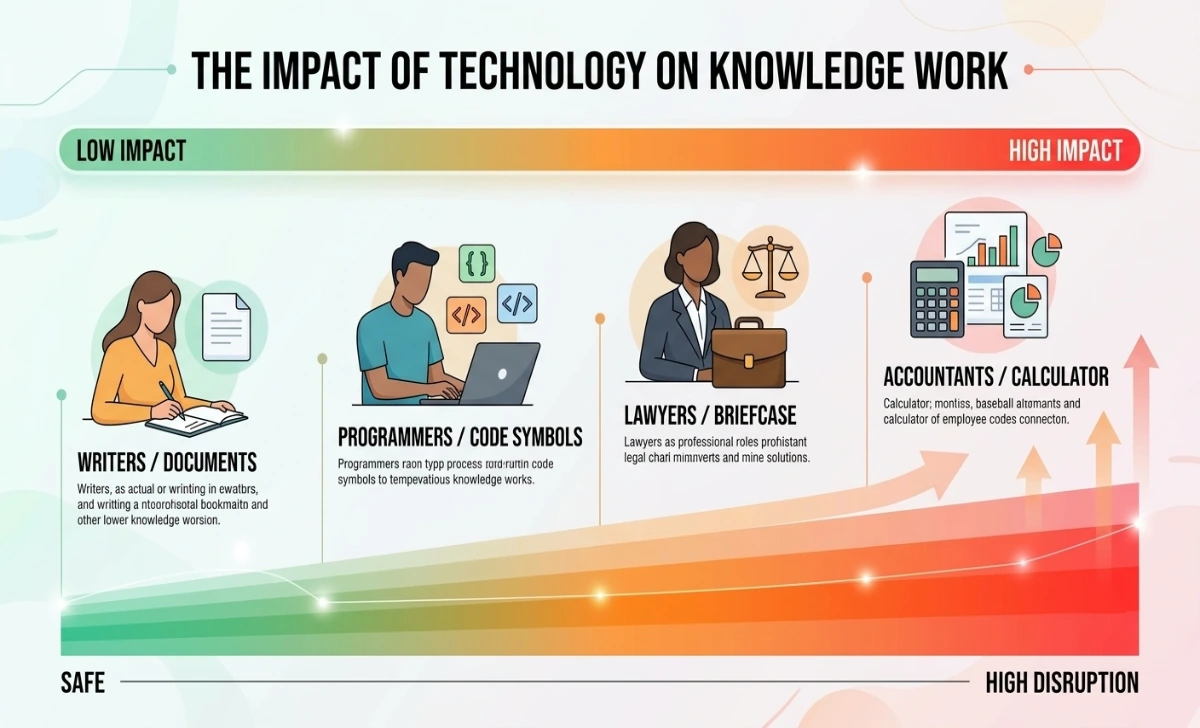
AGI development directly threatens knowledge work. Unlike the industrial revolution, which displaced manual labour, this wave targets educated professionals—writers, programmers, legal analysts, financial advisors. These roles face the highest near-term disruption.
Meta is investing $115-135 billion in AI infrastructure in 2026 alone. Global tech companies are spending over $600 billion on AI. This capital is flowing into real systems that businesses will adopt. Knowledge workers should prepare now.
What that means practically: the skill half-life is shortening. Expertise learned five years ago may be outdated. Businesses should experiment with AI workflows today rather than scrambling when competition moves first. Human-AI collaboration skills—knowing how to work with AI tools—will be more valuable than specialised technical skills that AI can replicate.
The winners will be people who understand AI’s trajectory and can adapt quickly.
Conclusion
Artificial General Intelligence has moved from theoretical to actual. Experts are actively debating whether we’ve already reached it, not whether it’s possible. The timeline remains contested, but investment and capabilities are accelerating. Risks and benefits are both substantial. Governance questions are urgent.
Your practical takeaway: stay informed about AGI developments. Build skills that require human judgment and creativity. Understand how AI will reshape your field. The skills that matter in an AGI world are different from today’s economy.
For insights on how AGI affects global hiring and remote work dynamics, explore how AI-driven global commerce is reshaping international business. Learn more about the future of remote and AI-managed work in our guide to permanent establishment and hiring abroad.
AGI isn’t coming in some distant future. The capabilities exist now. What’s uncertain is only the timeline and terminology. Stay ahead by understanding what’s actually happening rather than waiting for official declarations.
FAQs
Has AGI been achieved?
Experts disagree. Four UC San Diego scholars argue current LLMs qualify. Sam Altman says they’re missing critical capabilities. The debate hinges on definitions and what counts as human-level performance.
What’s the difference between AGI and superintelligence?
AGI matches human-level performance across multiple domains. Superintelligence exceeds human performance in virtually all domains, surpassing entire organisations of humans.
When will AGI arrive?
Predictions range from 2026-2027 to 2030+ to “unknown.” There’s no consensus, and definitions keep shifting.
Is AGI dangerous?
Views span from existential risk (Geoffrey Hinton) to practical engineering challenges (Yann LeCun). Most experts agree governance and safety are urgent priorities regardless of timeline.
How will AGI affect my job?
Knowledge work faces immediate disruption. Writing, programming, legal, and financial analysis roles will change structurally. Focus on human-AI collaboration skills and judgment-based work.
Who’s leading the AGI race?
US tech giants (OpenAI, Google, Anthropic, Meta) and Chinese companies (DeepSeek, Alibaba, Zhipu AI) are major players. The outcome depends on global adoption.





No Comment! Be the first one.