
You’ve probably read that Google wants “high-quality content,” but when you’re running a small blog without a famous brand or a six-figure marketing budget, it’s easy to feel like the algorithm is stacked against you. Every core update seems to favor big publishers, and you wonder whether something called “EEAT” will actually move the needle. The truth: EEAT for small blogs isn’t a VIP pass for large sites—it’s a framework you can leverage starting today, often faster than the giants can, precisely because you’re small enough to show real, human expertise at scale.
What Is EEAT (E-E-A-T)?
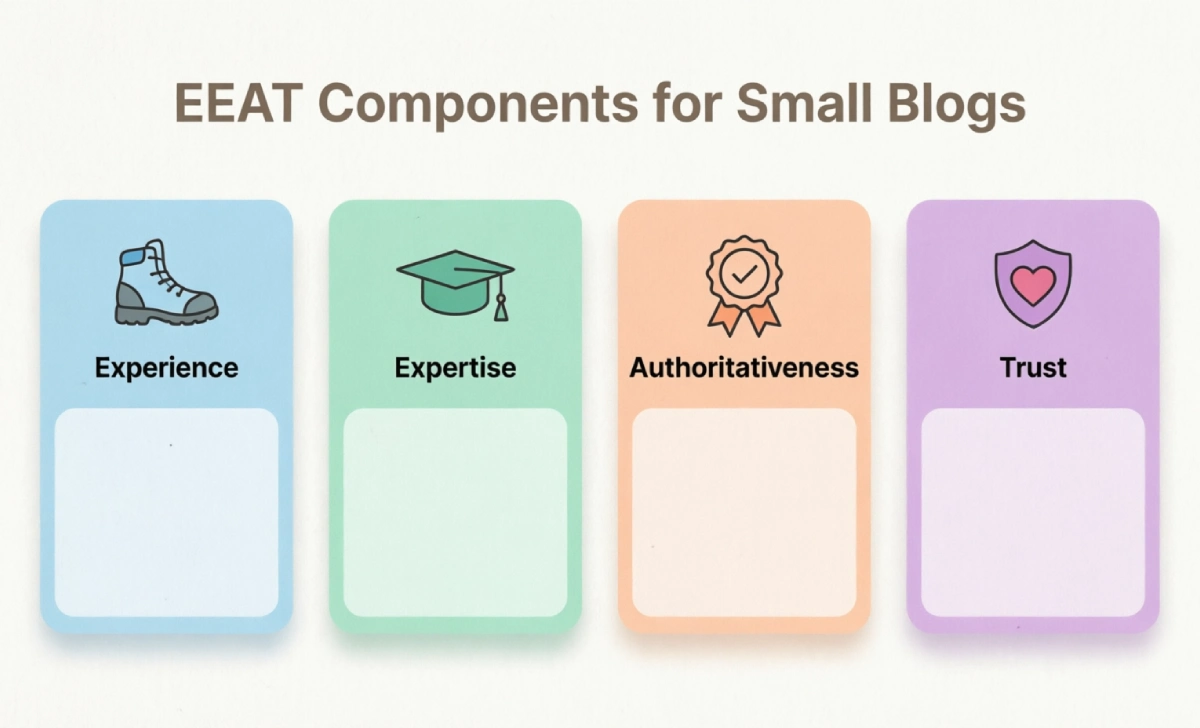
EEAT stands for Experience, Expertise, Authoritativeness, and Trust. It’s the set of criteria Google’s human Search Quality Raters use to evaluate whether a page is helpful, credible, and worthy of ranking. There’s no “EEAT score” in the algorithm, but Google’s systems are built to surface content that demonstrates strong EEAT signals.
Here’s a plain-English breakdown of each component:
- Experience: Did the creator actually live through the topic? A backpack review from someone who hiked 500 miles with it beats a summary scraped from Amazon listings.
- Expertise: Does the creator have formal knowledge, training, or great practical skill? A certified personal trainer writing about knee rehab carries more weight than a general health enthusiast.
- Authoritativeness: Is the creator—or the site—recognized as a go-to source by others? Authority comes from citations, mentions, and backlinks from reputable outlets.
- Trust: The most important piece. Trust is earned through accurate information, honest disclosures, and a clear record of keeping promises to readers.
Insert visual: Comparison table of EEAT components with a practical example for a small gardening blog. Alt-text: “EEAT components – Experience, Expertise, Authoritativeness, Trust – with blog examples.”
Does EEAT Actually Matter for Small Blogs?
If your blog covers YMYL (Your Money or Your Life) topics—health, finance, legal advice, safety—EEAT is make-or-break. But even for lifestyle, hobby, or entertainment blogs, EEAT matters more in 2025 than ever before.
Three reasons backed by data:
- Core updates reward “people-first” content. Google’s March, August, and November 2024 core updates refined how the helpful content system evaluates pages. Pages showing genuine experience and expertise gained visibility; those without lost it.
- EEAT correlates with higher rankings. A 2024 Backlinko study of 11.8 million search results found that pages with clear author bylines, external citations, and fresh content dominated top-10 positions for competitive queries.
- AI Overviews pull from high-EEAT sources. Google’s generative AI preferentially references trustworthy, authoritative content. Small blogs that nail EEAT have a real shot at appearing in AI Overviews, driving traffic even without a click.
HubSpot’s 2025 State of Marketing Report noted that 68% of marketers actively managing author profiles and citation practices saw an organic click increase within six months; those ignoring EEAT reported flat or declining traffic. EEAT isn’t optional if you want to compete against AI-generated noise.
Why Trust Is the Bedrock (and How Small Blogs Build It Fast)
Trust glues Experience, Expertise, and Authoritativeness together. A blog with fancy credentials still loses readers—and Google’s confidence—if it hides affiliate links, publishes outdated stats, or uses aggressive pop-ups.
Three trust-builders you can implement this week:
- Transparent ownership. Add an “About” page listing who runs the blog, your qualifications, and how you make money.
- Source everything. Link to primary sources or reputable studies. For instance, back a “Google processes 8.5 billion searches per day” claim with a link to the Google Search blog or Statista.
- Keep content fresh. Regularly update cornerstone posts and add a “Reviewed by [Name], 2026” note. This signals active maintenance to both users and search engines.
4 Actionable Steps to Build EEAT (Quick-Start Checklist Inside)
Small teams can move faster than enterprise content machines. Use that advantage.
Step 1: Showcase the Humans Behind the Content
Every post needs a visible author byline linked to a bio page packed with relevant real-world experience. Replace “Written by Admin” with “Written by Mia Chen, a certified diabetes educator and mother of two kids with Type 1 diabetes.” That instantly telegraphs expertise and lived experience.
Step 2: Rework Your Top 10 Posts for Experience Signals
Audit your best-performing posts. For each, ask: does the reader know why I’m qualified? Add a 1–2 sentence personal anecdote, a photo you took, or a short video clip demonstrating the product or process. One food blog added a 15-second taste-test video on each recipe post and saw a 23% lift in time on page and a 9% bump in organic clicks within 90 days—measured via Google Search Console.
Step 3: Build Authority Through External Validation
Reach out to a few niche websites and offer a guest post or expert quote. When they link back, they pass authority. Also, list yourself on Google Business Profile for local expertise and encourage genuine client reviews. For non-local blogs, get cited on Wikipedia, news outlets, or .edu pages by contributing original research or data.
Practical tools for this step:
- Google Search Console (free): Find pages ranking on pages 2–3; push them higher after adding EEAT signals and earning a few backlinks.
- HARO / Connectively (free): Answer journalists’ queries; a mention in a reputable outlet builds authority fast.
Step 4: Treat Every Update as a Trust Check-In
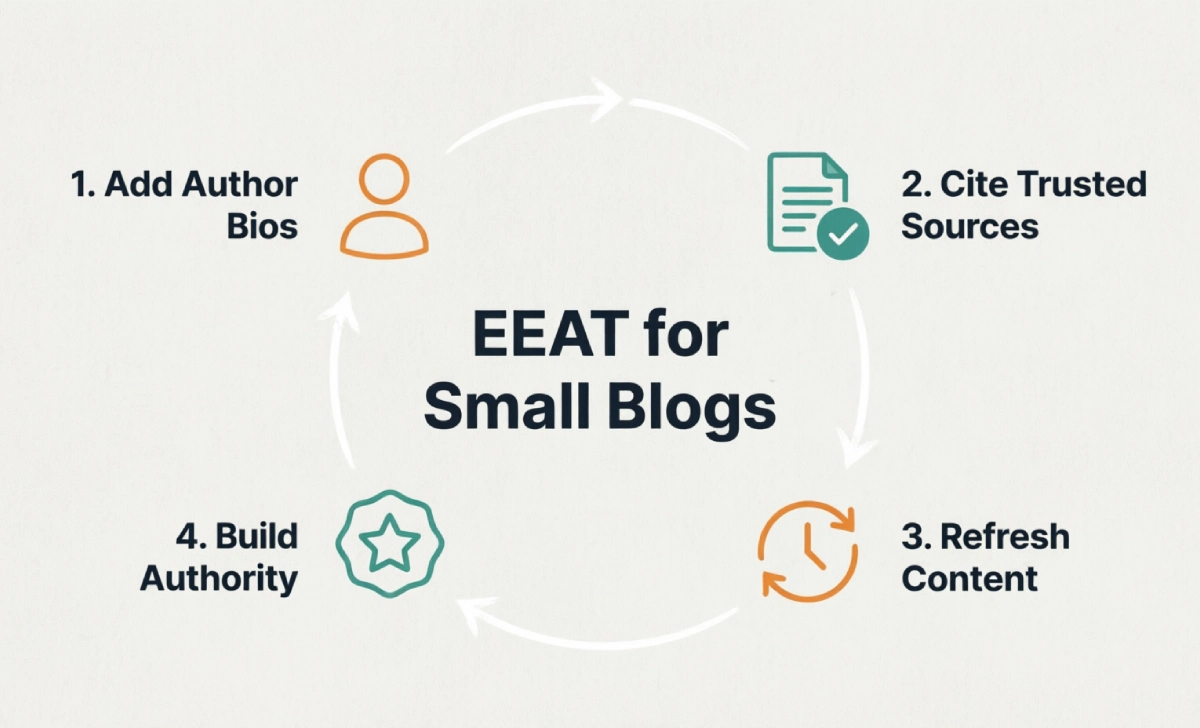
Set a quarterly calendar reminder to review top money and high-traffic posts. Update statistics, fix broken links, and add a “last reviewed” date. Small, consistent maintenance outperforms a huge once-a-year overhaul.
Insert visual: Simple flowchart showing the four-step EEAT improvement loop. Alt-text: “EEAT improvement loop for small blogs: add bios, cite sources, update content, earn trust signals, repeat.”
EEAT Quick-Start Checklist
- Clear author byline linked to a detailed bio with credentials on every post.
- Bio includes a “why trust me” statement with real-world experience.
- Top 10 posts contain at least one first-hand example, original image, or video.
- All claims supported by citations to reputable, recent sources.
- “About” page explains ownership, qualifications, and monetization.
- Affiliate links and sponsored content are disclosed per FTC guidelines.
- The site uses HTTPS, displays contact information, and has a privacy policy.
- Quarterly content review dates are scheduled.
How to Measure EEAT Impact on Traffic and ROI
Skip vanity metrics. Track these KPIs:
- Organic CTR: In Google Search Console, go to Performance → Average CTR. After adding richer author bios and meta descriptions, expect a climb.
- Average position: Monitor top 20 keywords. As EEAT signals strengthen, pages shift from positions 8–10 to 3–5.
- Engagement and conversions: Use GA4 to track newsletter sign-ups, product clicks, and inquiry forms from blog traffic. Tag all campaigns with UTM parameters (e.g., utm_source=blog&utm_medium=organic) to segment which EEAT-optimized pages drive business.
Test → Measure → Optimize mindset: Pick one high-potential post, add EEAT best practices, publish, wait 4–6 weeks, then pull a before-and-after Search Console report. If clicks and CTR rise, replicate. If not, tweak—maybe you need stronger external citations or a more compelling author story—then test again.
Tools:
- Google Search Console (free): Monitor clicks, impressions, CTR, and position changes per page.
- Looker Studio (free): Connect Search Console and GA4 to build a live dashboard comparing EEAT-optimized posts against blog-wide averages.
EEAT and the Future of Search: AI, Privacy, and What’s Next
Google’s 2025–2026 trajectory centers on generative AI, visual search, and a cookieless world. Here’s what it means for small blogs:
- AI Overviews prioritize EEAT. Trustworthy content, which shows first-hand experience and cites verifiable sources, is more likely to appear in AI snapshots. You don’t need a massive brand; you need to be transparently reliable.
- EEAT hedges against algorithm volatility. When core updates roll out, blogs with robust trust signals bounce back faster than thin, aggregated content.
- Privacy shifts push first-party relationships. With third-party cookies phasing out, earning direct trust matters more. Encourage newsletter sign-ups and community comments; they signal real people value your voice. EEAT reinforces that your site isn’t a content factory.
- AI-generated content isn’t a replacement. Google’s spam policies allow AI assistance only if humans with genuine experience review and enrich the work. Disclose substantial AI usage, and never let a tool be the final authority on YMYL topics.
EEAT alone won’t shoot you to #1. It works as part of a broader SEO strategy that includes solid technical foundations, relevant topic clusters, and earning quality backlinks. But in a world where anyone can generate a thousand articles with a click, the blogs that win prove there’s a real, trustworthy human behind every page.






No Comment! Be the first one.