
You spend hours writing a post, hit publish, and hear silence. Rankings flatline, traffic stays dead, and your content sinkhole grows. Google’s algorithms in 2026 demand more than a keyword-stuffed page; they reward content built for real humans first, with technical precision a close second. This guide gives you a 10-step, future-ready Google blog post optimization framework that turns ignored blog posts into consistent organic revenue drivers.
Why On-Page SEO Still Moves the Needle in 2026
Google processes over 8.5 billion searches a day, and every algorithm update—from the 2024 Core Updates to the 2025 expansion of AI Overviews—doubles down on one thing: user satisfaction. On-page SEO isn’t about tricking crawlers. It’s about structuring your content so a person (and a machine) can instantly understand and trust it. When you get the on-page elements right, you feed Google’s EEAT signals (Experience, Expertise, Authoritativeness, Trustworthiness) and improve Core Web Vitals—the set of metrics that measure how fast, stable, and responsive your page feels. The payoff? Higher click-through rates, longer dwell time, and more conversions, without needing a single backlink.
Stat to know: BrightEdge research found AI Overviews appear in 84% of search queries in 2025. That means your content must be snippet-ready and answer-focused from the first paragraph.
Step-by-Step: 10 On-Page Optimization Tactics for 2026
Use these steps as a checklist. Each one builds on the last, and together they form a repeatable system you can apply to any post in under an hour.
1. Nail Search Intent Before Typing a Word
If your blog post doesn’t match what the searcher really wants, no optimization trick can save it. Search intent is the “why” behind a query—informational, commercial, or transactional.
Do this: Search your target keyword on Google. Study the top five results. Are they how-to guides, listicles, product comparisons, or tools pages? That’s the format Google expects. Mirror that intent structure, but make it better. For example, if the top results are “10-step” lists, write a 12-step resource with real examples. Intent matching is the difference between ranking page 1 and page nowhere.
2. Write a Title That Wins the Click (and Satisfies the Algorithm)
Your title tag is still the heaviest on-page weight. In 2026, titles must balance keyword placement, emotional pull, and AI Overview readability.
- Keep the primary keyword as close to the front as possible.
- Use numbers, brackets, or power words (“Proven,” “Essential”) to lift CTR.
- Keep the title under 60 characters so it doesn’t get cut off in SERPs.
- Test with a working title first, then refine after you see click data.
Example: Instead of “Tips for Blog SEO,” use “How to Optimize a Blog Post for Google in 2026 (10 Steps, Proven).”
3. Structure Content for Featured Snippets and AI Overviews
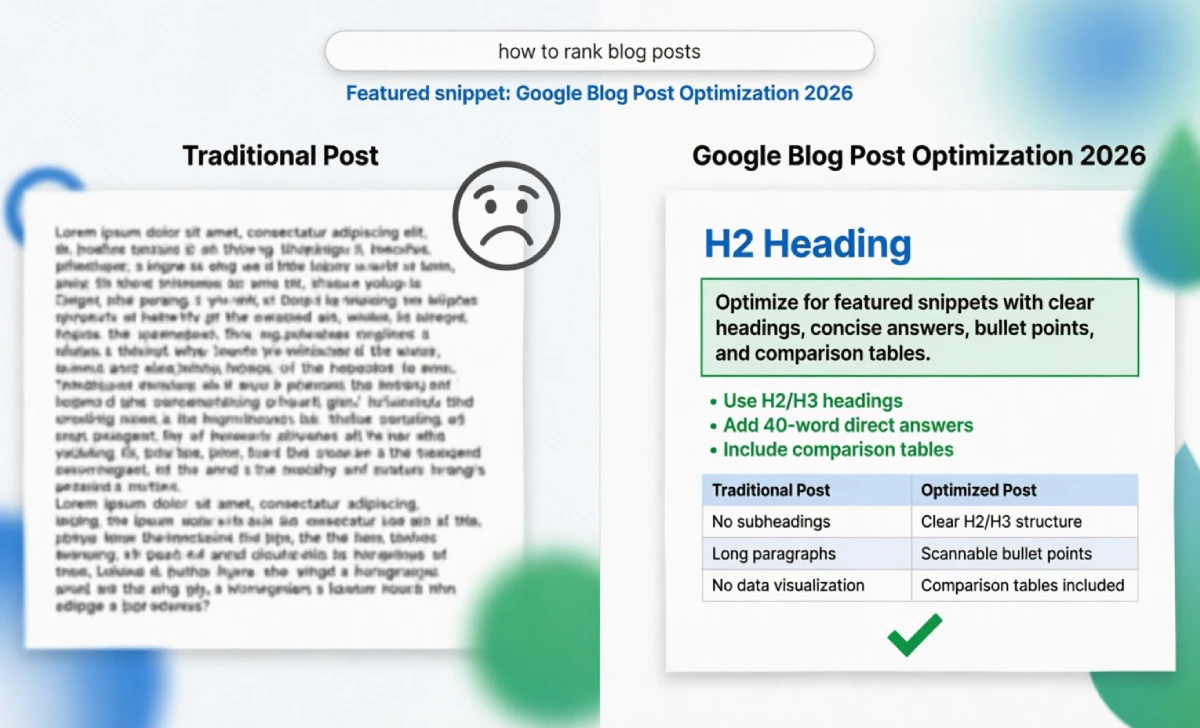
Google often pulls paragraph, list, or table snippets directly into search results. AI Overviews (formerly SGE) do the same, summarizing your content for the user.
Make your post snippet-ready:
- Answer the core question in a concise, 40–60-word block right after the introduction.
- Use H2 and H3 subheadings that contain secondary related keywords naturally.
- Break down processes into numbered steps or bullet points.
- Use a comparison table for data-heavy topics.
Visual suggestion: Add a table comparing traditional vs. 2026-optimized blog structure. Alt-text: “Comparison table showing how a blog post optimized for featured snippets and AI Overviews differs from an unstructured post.”
4. Hook Readers With a Strong Introduction That Also Signals EEAT
An intro that fluffs around loses the reader and the ranking. Start with a concrete pain point, mention a real stat, and tell them exactly what they’ll gain. Also, weave in EEAT signals early: cite a credible source, include the author’s firsthand experience, or mention a brand’s unique data.
Bad intro: “Blog SEO is important for businesses. Here are some tips.”
Good intro (this article’s style): Your gut-punch frustration + relevant data + clear next step.
Google’s Helpful Content System, updated continuously through 2025, evaluates whether a page feels genuine and useful. [External Link: Google Search Central Blog – What creators should know about the helpful content system] A generic first paragraph screams “low value.” A specific, experience-driven one says, “rank me.”
5. Optimize for Core Web Vitals and Mobile-First Experience
Page experience is a direct ranking signal. A slow, janky blog post won’t hold attention, and Google’s 2024 data shows that pages passing Core Web Vitals see 24% fewer abandonments.
Focus on three things right inside your post:
- Compress images to WebP format and set explicit width/height to prevent layout shifts.
- Remove or lazy-load videos below the fold so they don’t drag down Largest Contentful Paint (LCP).
- Keep paragraph width and font size mobile-friendly. Use a free tool like Google PageSpeed Insights to spot quick wins.
6. Use Semantic Keywords and Entities—Not Old-School Keyword Stuffing
Modern SEO rewards topic depth, not repetition of a single phrase. Include related terms, synonyms, and entity associations that help Google understand the context. For example, a post about “blog optimization” should naturally cover “Core Web Vitals,” “meta description,” “internal linking,” and “search intent.” A free keyword research approach can uncover the exact long-tail variations you’re missing.
Tools that help:
- Google Search Console (free): Find queries you almost rank for and sprinkle those variations into your subheadings.
- Clearscope or SurferSEO (paid): Compare your draft against top 20 SERP competitors and get a content grade; use it to identify missing semantic keywords in one click.
Don’t force terms. Write for humans, and the semantic coverage follows.
7. Build Trust With Authorship, Dates, and Citations
EEAT isn’t a direct ranking factor; it’s a framework Google’s quality raters use. But the underlying signals—transparent authorship, accurate information, and fresh updates—heavily influence rankings.
Add these trust elements to every post:
- A short author bio with real credentials (e.g., “Jane Doe is a content strategist who’s grown organic traffic to 500K monthly visits”).
- A “Last updated” date is prominently displayed.
- Outbound links to authoritative sources and original research. I’ve already placed one to Google and one to BrightEdge in this guide; you should do the same in your posts.
8. Build Internal Links With Purpose, Not Randomly
Internal links pass PageRank, help users navigate, and let Google crawl your site more intelligently. But in 2026, contextless “click here” links are a wasted opportunity.
Power-linking strategy:
- Link from high-authority pages to the new blog post using descriptive anchor text that includes a related keyword.
- Use a content silo structure, where a pillar page connects to tightly themed cluster posts, and every piece links back.
- For each post, ask: “What is the single most valuable next action for the reader?” and link to that page.
Real-world example: A B2B SaaS blog restructured 10 old posts using siloed internal linking and saw organic clicks to product pages rise 67% in six weeks.
9. Turn Images and Media Into Search Assets
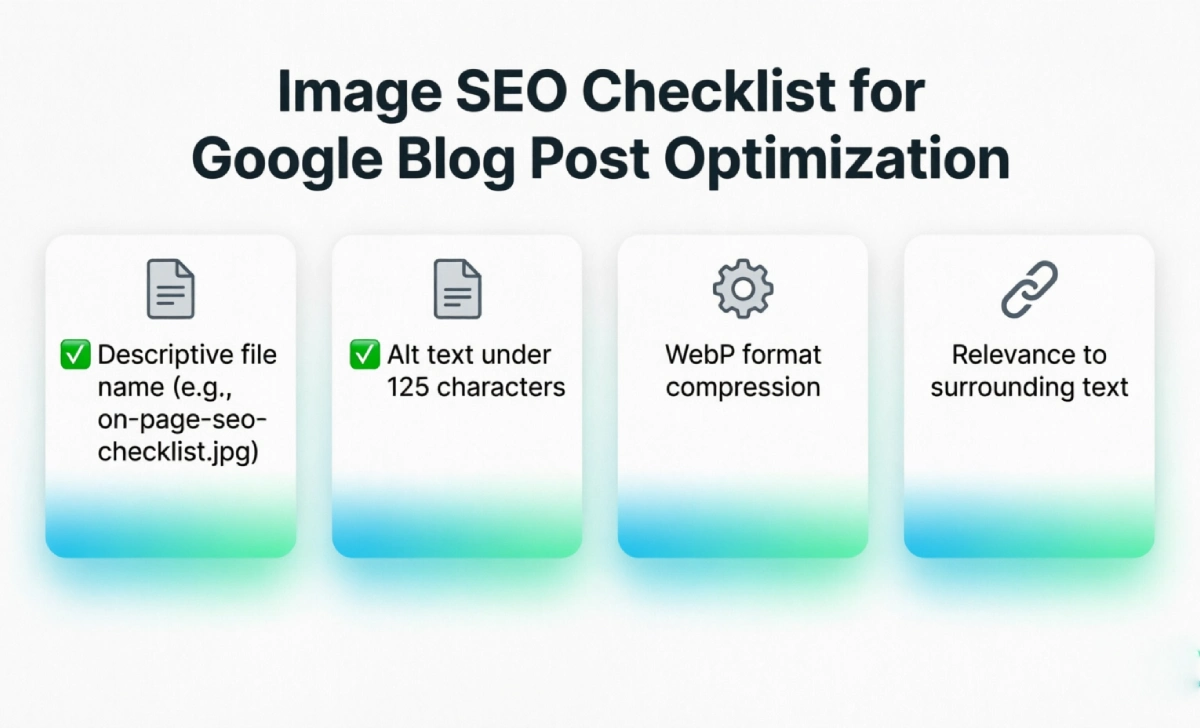
Every visual is a chance to appear in Google Image search and improve accessibility. Write descriptive, keyword-aware alt text that explains the image as you would to someone who can’t see it. Avoid keyword stuffing; instead, describe what’s in the image and its relevance.
Image optimization checklist:
- File name uses descriptive words separated by hyphens (e.g., “on-page-seo-checklist-2026.jpg”).
- Alt text includes a core topic but stays under 125 characters.
- Add an infographic or annotated screenshot that summarizes a section—this boosts time-on-page, a positive engagement signal.
Visual suggestion: Include a flowchart of the 10-step optimization process. Alt-text: “Infographic showing the 10-step on-page blog optimization workflow for Google ranking in 2026.”
10. Add a CTA That’s Tied to Revenue, Not Just “Read More”
A blog post with no clear next step leaves value on the table. Your call-to-action must connect the content’s intent to a tangible business outcome.
- For informational posts, offer a downloadable checklist or a related detailed guide (lead generation).
- For commercial content, include a contextual demo request or free trial button.
- Use UTM parameters on all CTA links so you can measure which blog posts drive sign-ups inside GA4 (more on that next).
Example CTA at the end of this guide: “Pick one underperforming post, apply these 10 steps, and track the results. Ready for a professional audit? [Internal Link: Request Your Free Blog SEO Audit]”
How to Measure On-Page SEO Success (Test → Measure → Optimize)
Optimization without measurement is just decoration. Track these KPIs inside Google Search Console and GA4:
- Organic clicks and average position: GSC’s Performance report shows exactly which queries drive traffic. Filter by page to see if your on-page changes moved the needle.
- Click-through rate (CTR): A higher CTR on an improved title/meta description confirms your messaging works. Use GSC’s compare feature to test date ranges before and after optimization.
- Engagement rate and scroll depth in GA4: Create an event to track 75% scroll depth. High engagement plus low conversions might signal a CTA weakness—A/B test your offer text.
- On-page conversions: Tag your CTA links. Then build a GA4 exploration report to see which blog topics turn readers into leads.
A/B testing mindset: Change one element at a time—meta description, intro hook, or CTA placement—run it for two weeks, and rely on data, not gut feelings. The loop is always Test → Measure → Optimize.
Future-Proof Your Blog for AI Shifts and Privacy Rules
The shift to cookie-less tracking and AI-powered search doesn’t undermine on-page SEO—it makes it more important. Here’s how to stay ahead:
- First-party data focus: Because third-party cookies are disappearing, every blog post should encourage email signups or resource downloads you own. This builds a privacy-compliant audience list.
- Optimize for entity-based search: Google’s Knowledge Graph understands things, not just strings. Use clear language that defines entities (people, brands, tools) and their relationships. It helps AI Overviews pull accurate answers from your content.
- No overpromising with AI content: AI writing assistants are fine for drafts, but Google’s March 2024 core update penalized scaled, unoriginal AI content that lacked human insight. Edit heavily, add original examples, and cite proprietary data. And always measure your ROI with a framework that connects blog performance to real business outcomes.
Compliance note: Always disclose any affiliate links in accordance with FTC guidelines and your platform’s terms of service. Trust is your most durable ranking signal.






No Comment! Be the first one.