Farmers are used to squeezing value out of every inch of land. So when someone says you can grow crops and generate solar electricity on the same field at the same time — without choosing one over the other — it’s worth paying attention.
That’s exactly what agrivoltaics does. And the benefits of solar panels on farmland go well beyond a second income stream.
Whether you’ve got 10 acres or 500, this guide breaks it down the way a farming neighbour would — no jargon, no academic whitepaper language, just the real picture.
What Is Agrivoltaics, Exactly?
The word sounds like it belongs in a university research lab. It really doesn’t.
So what is agrivoltaics, explained simply? It’s the practice of using the same piece of land for both solar energy production and active farming — simultaneously. You might also hear it called agri-PV or dual-use solar. Panels go up. Crops still go in the ground underneath or between them. Both systems run at the same time.
That’s the whole concept.
How the Dual-Use System Works
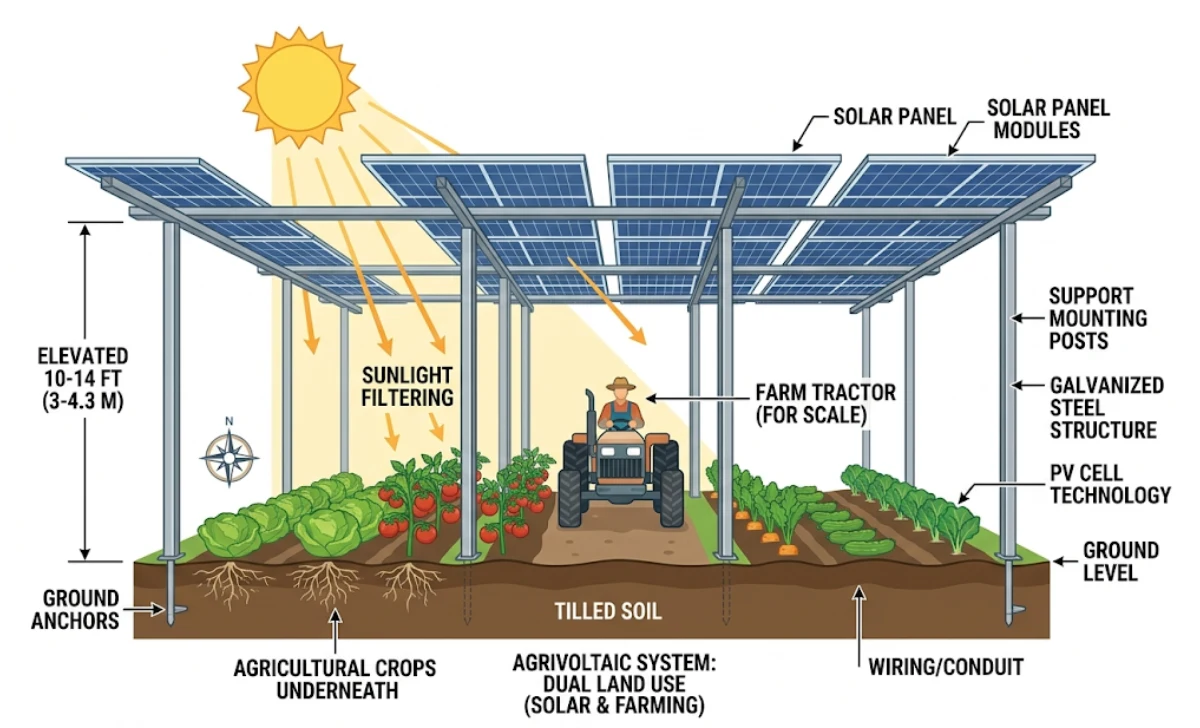
In a typical agrivoltaic setup, solar panels are mounted higher than standard ground-mounted arrays — usually 8 to 14 feet off the ground — to leave enough clearance for farm equipment or livestock. They’re spaced in rows with gaps wide enough to let sunlight reach the soil.
Some setups use fixed-tilt panels that shade a specific strip of ground permanently. Others use tracking systems that rotate with the sun, creating shifting shade patterns throughout the day.
The spacing, height, and panel density all depend on what you’re growing. Leafy greens and herbs need very different conditions than sunflowers or wheat.
A Brief History Worth Knowing
The concept isn’t as new as you’d think. A German researcher named Adolf Goetzberger proposed combining solar panels with agriculture back in 1981. It sat mostly in academic circles until around 2011, when a French research team ran the first large-scale agrivoltaic trial and published results that turned heads.
Since then, installations have popped up across Japan, Germany, France, South Korea, and increasingly across the United States — especially in states like Colorado, Massachusetts, and Minnesota, which have built policies specifically supporting it.
The Real Benefits of Solar Panels on Farmland
Here’s where it gets interesting — because this isn’t just about electricity.
Extra Income Without Giving Up Your Land
The most obvious benefit is financial. When farmers lease land to solar developers, they typically receive somewhere between $300 and $1,000 per acre per year, depending on location, land quality, and the terms negotiated.
With a traditional ground-mounted solar lease, that land is usually out of agricultural production for 25–30 years. That’s the trade-off most farmers struggle with.
Agrivoltaics changes that equation. You’re not surrendering the land — you’re adding a revenue layer on top of what’s already there. Your crops keep growing. Your livestock can still graze. And you’re collecting lease income or energy savings on top.
For a 50-acre operation, even a modest lease arrangement can mean an extra $15,000–$40,000 per year. That’s nothing.
For farmers thinking about long-term financial security, that kind of reliable annual income can quietly shape bigger decisions — including when it makes sense to start drawing from retirement benefits. If you’re weighing those choices alongside farm income planning, it’s worth understanding how claiming Social Security early can affect your long-term financial picture before locking anything in.
Water Conservation — One of the Biggest Surprises
This one catches most people off guard.
Shade from solar panels reduces soil evaporation, which means the ground underneath stays moist longer after rain or irrigation. Studies from the University of Arizona found that crops grown in agrivoltaic systems needed up to 157% less water than the same crops grown in open fields.
In drought-prone regions, that’s not a minor perk — it’s potentially the difference between a viable growing season and an expensive loss.
The panels also stay cooler when air moves beneath them, which slightly improves their electricity output compared to panels mounted flat on rooftops. It’s a two-way benefit most people never consider.
Environmental and Ecosystem Benefits
Bees, butterflies, and other pollinators have been quietly disappearing from conventional solar farms for decades — mostly because developers plant grass or gravel underneath panels and call it done.
Agrivoltaic farms flip that script. When you grow flowering plants, cover crops, or native wildflowers between panel rows, you create pollinator habitat at scale. A 2023 review in Frontiers in Sustainable Food Systems found that agrivoltaic sites host measurably more insect biodiversity than conventional solar sites within just two growing seasons. That matters beyond the feel-good factor — more pollinators directly support better yields on surrounding cropland.
Beyond pollinators, dual-use systems also reduce stormwater runoff, improve soil health through continuous root activity, and lower the land’s carbon footprint compared to stripped conventional solar sites.
Do Solar Panels Actually Affect Crop Yield?
This is the question every farmer asks first — and honestly, it’s the right one. So do panels actually block enough light to hurt your harvest?
The short answer: it depends entirely on what you’re growing.
What the Research Says
A landmark study published in Nature Sustainability tracked crop performance across multiple agrivoltaic sites and found that yields of shade-tolerant crops stayed equal to or exceeded open-field yields, while the panels simultaneously generated electricity. That’s the dual win the concept promises.
But — and this matters — crops that need full sun all day, like corn or soybeans grown for maximum commodity yield, don’t perform as well under panels. The shade disrupts their photosynthesis enough to reduce output meaningfully.
This doesn’t make agrivoltaics wrong for those operations. It means the crop selection has to be intentional.
Crops That Thrive vs. Struggle Under Panels
Tend to thrive:
- Leafy greens (lettuce, spinach, kale)
- Herbs (basil, cilantro, mint)
- Root vegetables (beets, carrots, radishes)
- Berries (strawberries, raspberries)
- Pasture grasses for grazing livestock
Tend to struggle:
- Field corn
- Soybeans (conventional high-density planting)
- Sunflowers
- Any crop that requires maximum direct sunlight for peak yield
The pattern is consistent: crops that naturally grow in partial shade or woodland edges tend to adapt well. Crops bred for open prairie conditions tend not to.
Best Crops to Grow Under Solar Panels
Shade-Tolerant Varieties That Perform Well
If you’re planning a small agrivoltaic setup, here are some of the most reliable options based on current research and real farm trials.
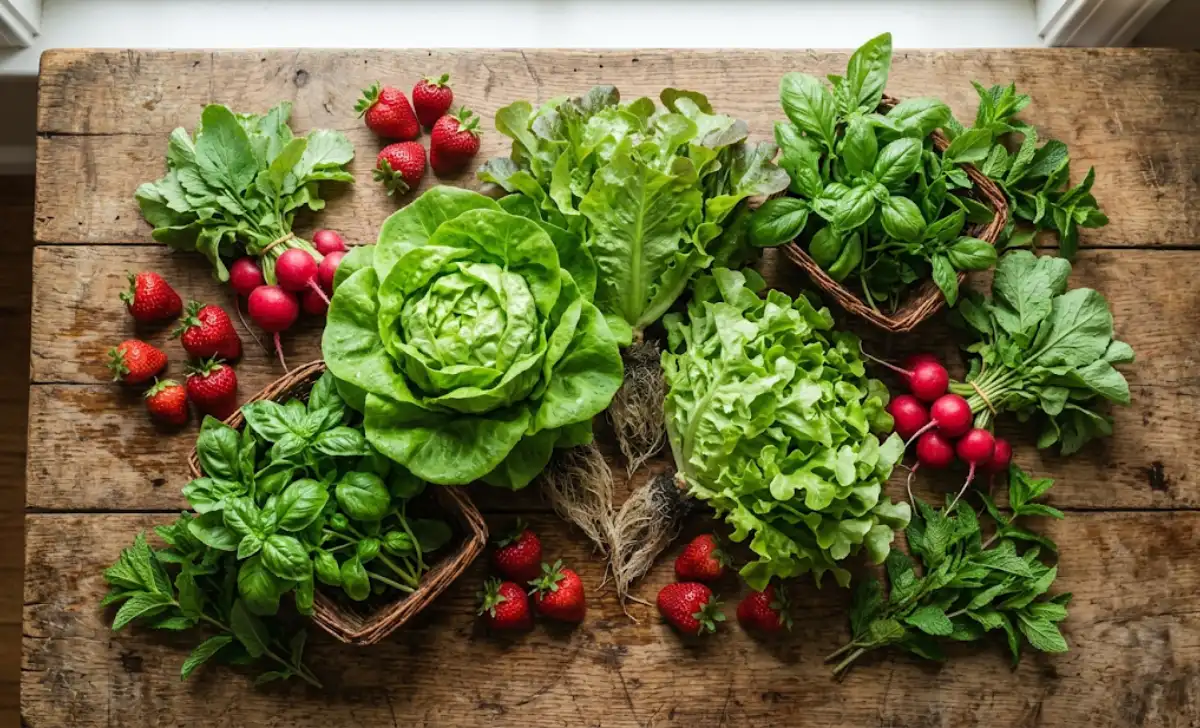
Lettuce and salad greens are probably the top performers. They bolt (go to seed prematurely) in intense heat — shade from panels actually extends the growing season and improves leaf quality. Farmers in Arizona and California have reported growing lettuce through summer months they previously had to skip entirely.
Strawberries do remarkably well. They’re a partial-shade crop by nature, and the reduced heat stress under panels can improve fruit quality. The ground stays cooler and more moist, which cuts irrigation demand significantly.
Herbs — particularly basil, cilantro, and parsley — thrive in filtered light and command premium prices at farmers’ markets or through a direct farm store. That improves your return per square foot dramatically compared to commodity crops. If you’re moving into direct-to-consumer sales online, getting your payment infrastructure set up correctly from day one saves a lot of friction once orders start coming in.
Sheep and goats are a surprisingly popular choice for the space between panel rows. They graze the vegetation that grows naturally, keep the area maintained without mowing equipment, and produce wool or meat as a secondary product. Several solar farms in the UK and the US have adopted this as standard practice.
Pollinator cover crops — clover, wildflowers, buckwheat — don’t generate direct crop income, but they support nearby horticulture and can be part of a conservation program that includes federal cost-share payments.
Is Agrivoltaics Right for Small Farms?
When it comes to agrivoltaics for small farms, the honest answer is: sometimes yes, sometimes no — and it depends on factors you can actually control.
Scale Requirements and Land Minimums
Large commercial solar developers typically aren’t interested in parcels under 20–30 acres for lease arrangements. The economics don’t work on their end for smaller plots.
But that doesn’t close the door for small farmers. A few realistic paths exist:
Community solar participation — Some states allow small landowners to host portions of a larger community solar array, with lower acreage thresholds. Minnesota’s community solar program, for example, has been used by farms as small as 5 acres.
On-farm energy production — A small agrivoltaic array sized for your own electricity use (not utility-scale) can be installed on 1–5 acres and offset your farm’s power bills significantly. At $0.12–$0.18/kWh for farm electricity, the savings add up fast.
Cooperative arrangements — A handful of neighbouring small farms in some regions have pooled adjacent parcels to meet developer minimums. It’s not common yet, but it’s happening.
Grants and Programs Available to Small Farm Owners
This is where things get genuinely useful. The U.S. has several funding sources specifically targeting farms considering renewable energy:
- USDA REAP (Rural Energy for America Program) — Grants and loan guarantees covering up to 50% of eligible project costs for agricultural producers installing renewable energy systems.
- IRA Clean Energy Tax Credits — The Inflation Reduction Act extended and expanded investment tax credits for solar installations, including those on agricultural land, through at least 2032.
- State-level agrivoltaic incentives — Massachusetts, Colorado, and New Mexico have specific programs supporting agrivoltaic research and installation on working farms.
A conversation with your local USDA Farm Service Agency office is worth 30 minutes of your time before you assume this isn’t affordable.
How to Get Started: Practical First Steps
Don’t sign anything until you understand what you’re agreeing to.
Questions to Ask Before Signing a Solar Lease
If a developer approaches you about leasing farmland for solar, these are non-negotiable questions:
- Is this a conventional ground-mount or an agrivoltaic design? If it’s conventional, your land is out of production. Know exactly which type is on the table.
- What are the setback requirements? Panels may need to be 50–100+ feet from property lines, roads, or structures, which directly affects how much of your land stays usable.
- What happens at the end of the lease term? Who pays for removal? Is that in writing?
- Can you still farm the land between or under the panels? Get this in the contract, not just verbally confirmed.
- What is the escalation clause on lease payments? Flat payments for 30 years means inflation eats your income. Push for annual escalators tied to CPI.
Is Agrivoltaics Right For You? A Simple Self-Check
Before you commit time or money, run through these honestly. How many can you check off?
- [ ] You have at least 5 acres of relatively flat, unshaded land
- [ ] You’re in a state with net metering or community solar policies
- [ ] You’re growing (or willing to grow) shade-tolerant crops
- [ ] You’ve checked USDA REAP eligibility in the past 12 months
- [ ] You’ve gotten at least two independent quotes from solar installers with agrivoltaic experience
If you checked four or five, this is genuinely worth pursuing.
Worth noting: managing a solar installation involves more moving parts than most people expect. Contractor bids, utility interconnection agreements, permitting timelines, and crop plan adjustments. It’s a real project coordination effort, not just a handshake with a developer. Farmers who’ve worked through large capital projects before — or who understand how complex projects get scoped, tracked, and delivered — tend to negotiate better terms and avoid costly mid-project surprises.
Grant Resources Worth Bookmarking
If funding is the main thing holding you back from exploring this further, here’s where to start:
- USDA REAP portal (farmers.gov) — check eligibility and access application support directly
- DSIRE (Database of State Incentives for Renewables & Efficiency) at dsireusa.org — search your state for active agrivoltaic or solar farm programs
- Your state’s department of agriculture — many have dedicated renewable energy liaisons who know about programs that aren’t widely advertised
Most farmers are surprised by how much they qualify for. The REAP grant alone can cover up to half of a project’s eligible costs. The applications take time, but that’s an argument for starting now, not later.
Where to Go From Here
Agrivoltaics isn’t a perfect fit for every farm. But for farmers already thinking about diversifying income, cutting water costs, or adding an environmental angle to their operation, it’s one of the more practical options available right now.
The research is no longer experimental. Real farms are producing real crops alongside real electricity, in real climates, with real returns. What was a university pilot project ten years ago is showing up on working farms across the country today.
The clearest next step is two phone calls: one to your local USDA office about REAP eligibility, and one to a solar installer with documented agrivoltaic experience in your region.
Start there. The answers will tell you more than any article can.
FAQs
Does shade from solar panels hurt all crops?
No. Shade-tolerant crops — leafy greens, herbs, berries, root vegetables, and pasture grasses — typically perform well or even better under panels. Full-sun commodity crops like corn and soybeans are more challenging and generally not the right fit for agrivoltaic systems.
How much money can a farmer realistically make from an agrivoltaic setup?
It varies widely. Solar lease income for agrivoltaic land typically runs $300–$1,000 per acre per year. Combined with continued crop or livestock income, the total return can meaningfully exceed what either use alone would generate. Energy savings from on-farm solar can also reduce operating costs by thousands annually, depending on farm size.
Do you need special equipment to farm under solar panels?
Possibly. If panels are mounted high enough (10+ feet), standard tractor equipment may pass underneath. Lower-mounted systems typically limit you to hand tools, small walk-behind equipment, or grazing animals. Sort this out with your installer before design is finalised — retrofitting is expensive.
Are there grants specifically for agrivoltaics in the US?
Yes. USDA REAP is the most accessible federal option. States like Massachusetts, Colorado, and Minnesota have specific programs, too. Best starting point: your local USDA Farm Service Agency office or your state’s agriculture department. Both are free calls.



No Comment! Be the first one.